Batfish (assorted)
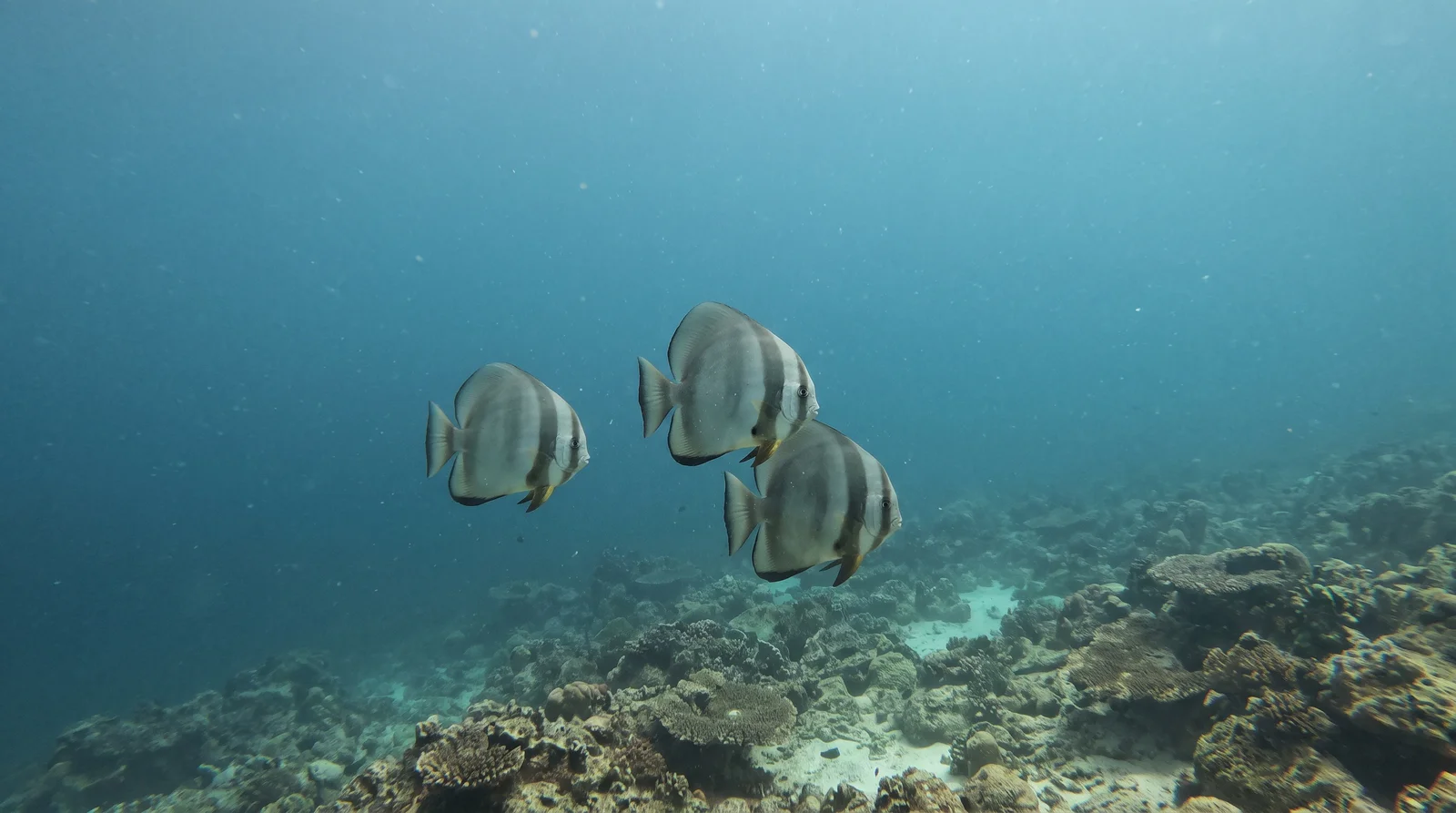 AI-generated
Image credit: AI-generated illustration · License unspecified · Source unspecified
Platax spp.
About Batfish (assorted).
Batfishes of the genus Platax are tall, laterally compressed reef fishes in the spadefish family Ephippidae. This group entry covers batfish sightings where the species was not recorded. Diveity also has individual pages for the Longfin Batfish (P. teira) and the Pinnate Batfish (P. pinnatus). The World Register of Marine Species (WoRMS) lists five accepted Platax species: P. batavianus, P. boersii, P. orbicularis, P. pinnatus and P. teira. These are the batfishes that divers usually see hovering in mid-water on Indo-Pacific reefs and wrecks.
The name "batfish" is also used for an unrelated group: the flattened, bottom-dwelling batfishes of the family Ogcocephalidae, which WoRMS places in the anglerfish order Lophiiformes. They are not covered by this entry. Because juvenile and adult Platax often look and behave differently, the young and old of one species can easily be mistaken for different fish.
Identification
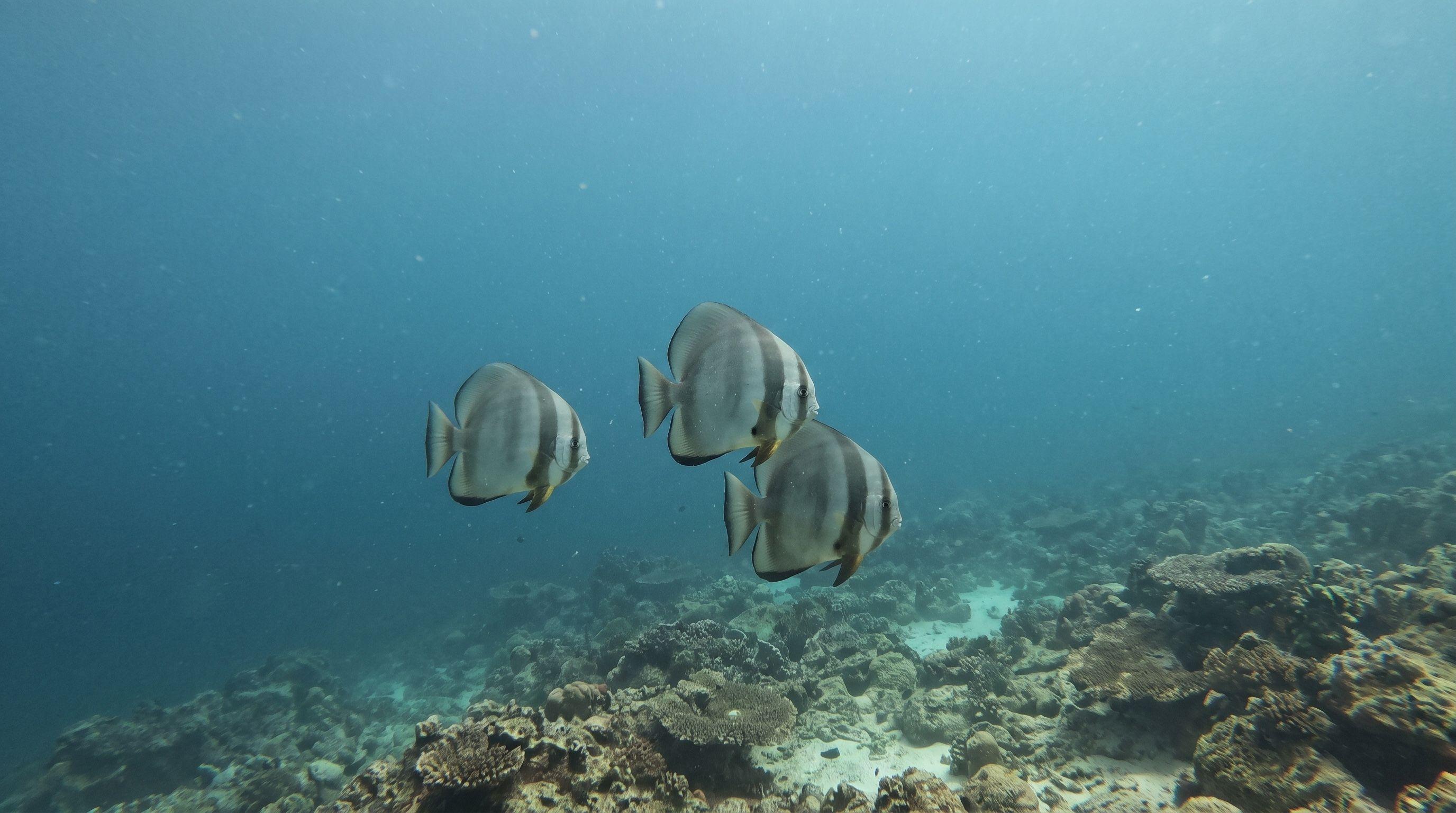
- Shape: Deep, disc-shaped bodies that look almost round from the side; adults are generally silvery, and juveniles have much taller fins than adults.
- Size: FishBase gives maximum lengths of 70 cm for P. teira and 45 cm for P. pinnatus.
- Juveniles: They can look very different from adults. FishBase describes juvenile P. pinnatus as dark brown to black with a brilliant crimson margin around the entire fish, while adults are dull silver with short fins.
- Markings: Adults often show dark vertical bands across the head and body; separating species underwater usually depends on fin shape and markings, so photographs that show the whole fish help with later identification.
Conservation status varies by species. FishBase reports IUCN Red List assessments of Least Concern for P. teira (assessed in 2018) and P. pinnatus (assessed in 2023). FishBase lists P. teira as harmless to humans, and notes that it is edible but not highly valued and is not an important gamefish.
Where it lives.
Batfishes of the genus Platax are reef-associated fishes of the Indo-West Pacific. FishBase gives the range of P. teira as the Red Sea and East Africa to Papua New Guinea, north to the Ryukyu Islands and south to Australia. It gives the range of P. pinnatus as the western Pacific from the Ryukyu Islands to Australia, and considers records from the Indian Ocean doubtful. FishBase adds that P. teira has been recorded in New Zealand's Bay of Islands and reported from the Persian Gulf.
Where Divers Find Them
- Depth: FishBase gives 3–25 m for P. teira and 15–30 m for P. pinnatus.
- Adults: P. teira adults occur on lagoon and seaward reefs, with large adults in sheltered bays and deeper offshore water and often around shipwrecks. P. pinnatus adults shelter under overhangs on steep outer reef slopes to at least 20 m.
- Juveniles: Small P. teira juveniles drift with floating debris and live on shallow, protected inner reefs. Juvenile P. pinnatus live in mangroves and on sheltered inner reefs, hiding in caves or under ledges.
- Floating cover: FishBase notes that both juveniles and adults of P. teira can school under large rafts of Sargassum seaweed.
For divers, wrecks, reef slopes with overhangs and the water just off the reef edge are good places to look for adults, while shallow sheltered reefs and mangrove edges are where juveniles are more likely to be seen. Juvenile P. pinnatus in particular stay close to cover in caves and under ledges, so they are easily missed without a careful look.
How it behaves.
Batfishes are calm, slow-moving fishes. FishBase describes adult P. teira as commonly found in small groups and occasionally forming large schools, with juveniles gathering in aggregations. Adult P. pinnatus are usually solitary but sometimes form large schools moving over open substrate. This mix of solitary fish, small groups and occasional schools means that encounters can vary considerably from one dive to the next.
Underwater Encounter Behavior
Divers commonly meet batfish hovering in mid-water near a wreck or reef edge, alone or in groups that turn together. Some individuals come quite close to divers, while others keep their distance. FishBase lists the diet of P. pinnatus as algae, jellyfish and other gelatinous zooplankton. Juveniles behave differently from adults: juvenile P. pinnatus keep to caves and ledges in sheltered habitats, and young P. teira drift with floating debris, so the same species can be met in quite different settings depending on its age. FishBase notes that adult P. teira are often found around shipwrecks, and that juveniles and adults of this species can school together under floating rafts of Sargassum.
Diver Tips
- Let them come to you: Batfish often hold position near divers; slow movements and steady breathing give the best encounters.
- Do not feed: Avoid feeding batfish or any other reef fish, as it changes natural behaviour.
- Check under debris: In calm conditions, look under floating material and seaweed rafts for juveniles.
- Look up on wrecks: Adults often hang above or beside wreck structure rather than resting on the bottom.
- Juvenile colours: A small, dark fish with a bright crimson edge hiding under a ledge in sheltered water is likely a juvenile Pinnate Batfish.
- Different batfish: A flattened fish moving along the bottom on its fins is likely a batfish of the family Ogcocephalidae, a different group from Platax.
Where to see it.
Evidence for philippines · 11 dive sites
General range is not evidence of occurrence at a specific dive site.
Camia II Wreck
Boracay
Documented site occurrence
Season not yet documented
Source reviewed on 2026-10-14 · Source: New Wave Divers Boracay (dive-site page) · Observation date not documented
Eva's Point
Sipalay
Documented site occurrence
Season not yet documented
Source reviewed on 2026-10-14 · Source: cbartazo.com "Seeking Sipalay" trip report (2017-10-28, single diver, Artistic Diving guest) · Observation date not documented
Hilutungan Island Sanctuary
Mactan
Documented site occurrence
Season not yet documented
Source reviewed on 2026-10-14 · Source: Green Sea Divers, Hilutungan Marine Sanctuary page (2011) · Observation date not documented
Julien's Wreck
Sipalay
Documented site occurrence
Season not yet documented
Source reviewed on 2026-10-14 · Source: Sea Explorers Sipalay, "Sipalay Dive Sites" page · Observation date not documented
Laguna
Boracay
Documented site occurrence
Season not yet documented
Source reviewed on 2026-10-14 · Source: New Wave Divers Boracay (dive-site page) · Observation date not documented
MS Jojo
Sipalay
Documented site occurrence
Season not yet documented
Source reviewed on 2026-10-14 · Source: Artistic Diving & Beach Resort, dive-sites page (Wayback snapshot 2019-10-21) · Observation date not documented
Shangri-La Marine Sanctuary
Mactan
Documented site occurrence
Season not yet documented
Source reviewed on 2026-10-14 · Source: Kontiki Divers / Seven Seas Aquanauts, Mactan dive spots page · Observation date not documented
Spiral Drops
Sipalay
Documented site occurrence
Season not yet documented
Source reviewed on 2026-10-14 · Source: Artistic Diving & Beach Resort, dive-sites page (Wayback snapshot 2019-10-21) · Observation date not documented
Talima Marine Sanctuary
Mactan
Documented site occurrence
Season not yet documented
Source reviewed on 2026-10-14 · Source: Bohol-Philippines.com, Olango Island dive sites (Polaris Dive Center text; Wayback snapshot 2024-11-08) · Observation date not documented
Tribird
Boracay
Documented site occurrence
Season not yet documented
Source reviewed on 2026-10-14 · Source: New Wave Divers Boracay (dive-site page) · Observation date not documented
Yapak
Boracay
Documented site occurrence
Season not yet documented
Source reviewed on 2026-10-14 · Source: New Wave Divers Boracay (dive-site page) · Observation date not documented
Gallery.
 AI-generated
AI-generated illustration
Image credit: AI-generated illustration · License unspecified · Source unspecified