Lionfish (assorted)
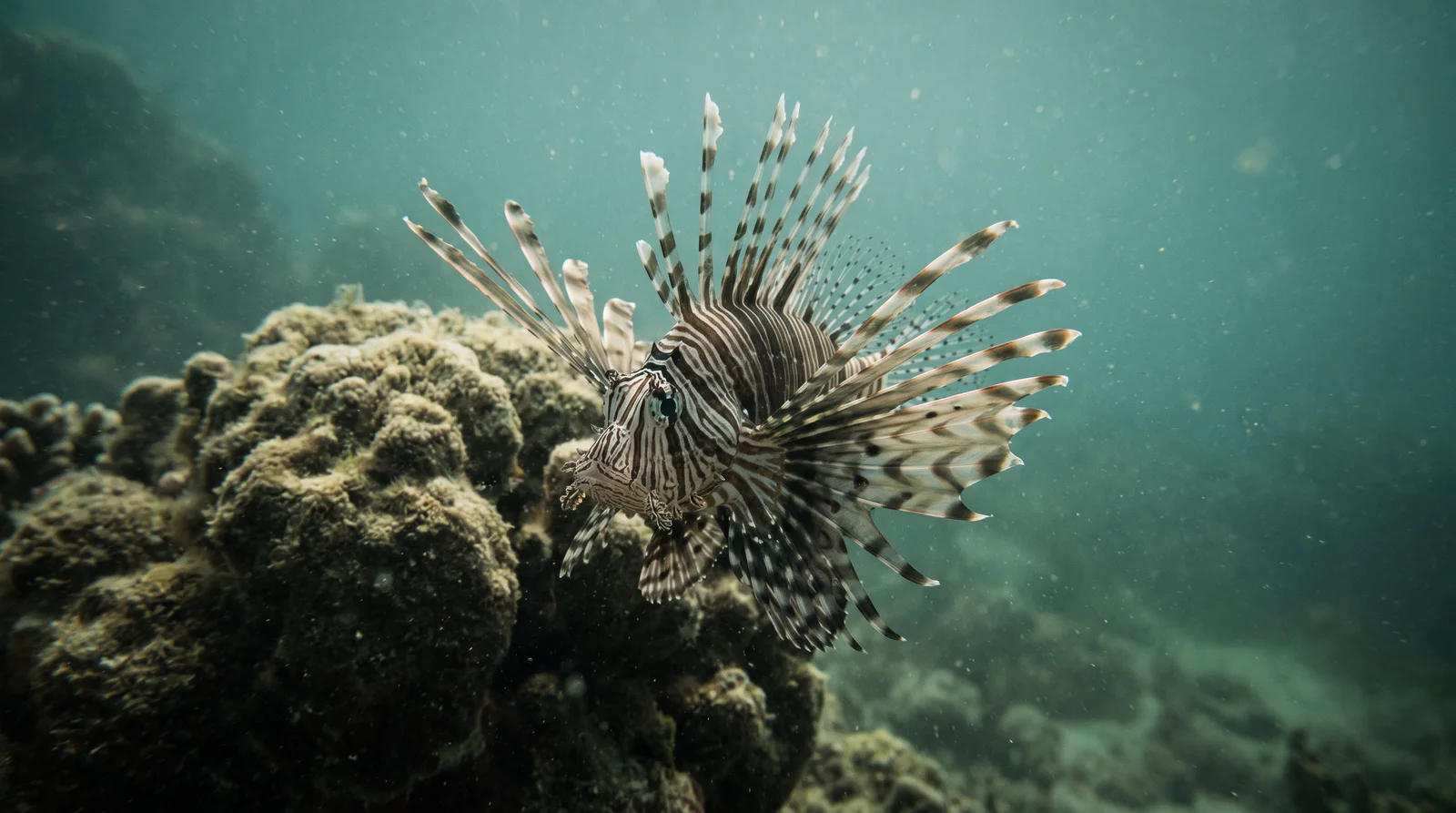 AI-generated
Image credit: AI-generated illustration · License unspecified · Source unspecified
Pteroinae spp.
About Lionfish (assorted).
Lionfishes are venomous scorpionfishes of the subfamily Pteroinae (family Scorpaenidae), recognised by their long, separated fin spines and broad, fan-like pectoral fins. This group entry covers lionfish sightings where the species was not recorded. Diveity also has individual pages for the Red Lionfish (Pterois volitans), the Common Lionfish of the Red Sea (Pterois miles) and the Twin-spot Lionfish. The World Register of Marine Species (WoRMS) lists several genera in Pteroinae, including Pterois, Dendrochirus, Nemapterois, Parapterois and Brachypterois. FishBase currently lists the Twin-spot (Twospot) Lionfish as Nemapterois biocellatus; many guides still call it Dendrochirus biocellatus. NOAA notes that members of Pterois are also known as turkeyfishes and zebrafishes.
Lionfishes are native to the Indo-Pacific. FishBase notes that the very similar P. miles replaces P. volitans from the Red Sea to Sumatra. NOAA reports that lionfish have also become established as an invasive species in the western Atlantic, along the southeastern coast of the United States and in the Caribbean.
Identification
- Fins: Long, mane-like dorsal spines and large pectoral fins spread like fans.
- Colour: Commonly banded in red, brown or maroon and white, with patterns that differ between species.
- Size: FishBase gives a maximum length of 45.7 cm for P. volitans and 13 cm for the Twospot Lionfish (N. biocellatus), with a maximum published weight of 1.4 kg and a maximum reported age of 10 years for P. volitans.
- Similar species: P. volitans and P. miles are very similar, so location is often the most practical clue in the field.
Conservation status varies by species. FishBase reports IUCN Red List assessments of Least Concern for P. volitans and N. biocellatus (both assessed in 2015). In the invaded western Atlantic, NOAA reports that lionfish eat more than 50 species of fish, including economically and ecologically important ones.
Where it lives.
In their native range lionfishes are reef-associated fishes of tropical Indo-Pacific waters. FishBase describes P. volitans on lagoon and seaward reefs, from turbid inshore areas down to about 50 m, with a listed temperature range of 22–28 °C. Its native range extends from the Cocos-Keeling Islands and Western Australia east to the Marquesas, north to southern Japan and Korea, and south to Lord Howe Island and northern New Zealand. FishBase notes that its pelagic juveniles disperse over great distances, and NOAA reports juveniles collected as far north as Long Island, New York, and Bermuda.
Where Divers Find Them
- Depth: FishBase gives 2–55 m for P. volitans and 1–40 m for N. biocellatus. In the western Atlantic, NOAA reports lionfish from about 0.3 m to 90 m (1–300 ft), and a 2015 Caribbean survey recorded them at about 234 m (768 ft).
- Shelter: By day they often rest in sheltered spots such as caves, crevices and overhangs; FishBase notes that the Twospot Lionfish hides in caves and sponges.
- Structures: NOAA lists hard bottom, mangroves, seagrass, coral and artificial reefs among the habitats used in the Atlantic, so wrecks and other artificial structures are worth checking.
- Water clarity: FishBase describes N. biocellatus as an uncommon inhabitant of clear, coral-rich waters, while P. volitans also occurs in turbid inshore areas.
Lionfish rarely stray far from cover, so slow, close inspection of reef structure, wrecks and overhangs is usually more productive than searching open water, especially toward dusk and at night when they become more active.
How it behaves.
Lionfishes are predators that rely on their venomous spines rather than speed for defence. FishBase describes P. volitans as mainly nocturnal and often solitary, hiding in sheltered spots by day, often head-down and barely moving. NOAA notes that in the Atlantic they are often seen moving about during the day as well.
Underwater Encounter Behavior
Lionfish hunt by ambush and slow pursuit. Both FishBase and NOAA describe them using their wide pectoral fins to corner prey, which FishBase says is then swallowed in a single motion. FishBase lists the diet of P. volitans as small fishes, shrimps and crabs; the Twospot Lionfish also feeds on small fishes and crustaceans and is secretive, mostly seen at night. The Australian Museum notes that when disturbed by a diver, a lionfish often makes little effort to swim away and instead points its dorsal spines toward the intruder. NOAA reports that lionfish reproduce year-round, with a mature female releasing roughly two million eggs per year. NOAA describes venom glands lying within two grooves of each spine, with a venom containing protein, a neuromuscular toxin and acetylcholine.
Diver Tips
- Venomous spines: The Australian Museum states that all 13 dorsal spines, the pelvic spine and the 3 anal spines of P. volitans are venomous. Never touch or corner a lionfish, and watch your hands and knees near ledges and wrecks.
- If stung: NOAA reports that stings can cause extreme pain, sweating, respiratory distress and paralysis, with effects lasting days, and advises seeking medical attention immediately. FishBase mentions heating the affected area as a treatment; follow your dive operator's first-aid protocol and get medical care.
- Keep a margin: A lionfish that turns its spines toward you is defending itself; back away slowly.
- Night dives: Lionfish are often more active after dark, so take extra care with spines when moving close to reef structure in limited visibility.
Where to see it.
Evidence for mactan · 4 dive sites
General range is not evidence of occurrence at a specific dive site.
Marigondon Cave
Mactan
Documented site occurrence
Season not yet documented
Source reviewed on 2026-10-14 · Source: Kontiki Divers / Seven Seas Aquanauts, Mactan dive spots page · Observation date not documented
Shangri-La Marine Sanctuary
Mactan
Documented site occurrence
Season not yet documented
Source reviewed on 2026-10-14 · Source: Kontiki Divers / Seven Seas Aquanauts, Mactan dive spots page · Observation date not documented
Talima Marine Sanctuary
Mactan
Documented site occurrence
Season not yet documented
Source reviewed on 2026-10-14 · Source: Bohol-Philippines.com, Olango Island dive sites (Polaris Dive Center text; Wayback snapshot 2024-11-08) · Observation date not documented
Tambuli
Mactan
Documented site occurrence
Season not yet documented
Source reviewed on 2026-10-14 · Source: 7 Seas Dive Center Cebu, dive sites page (Wayback snapshot 2024-06-14) · Observation date not documented
Gallery.
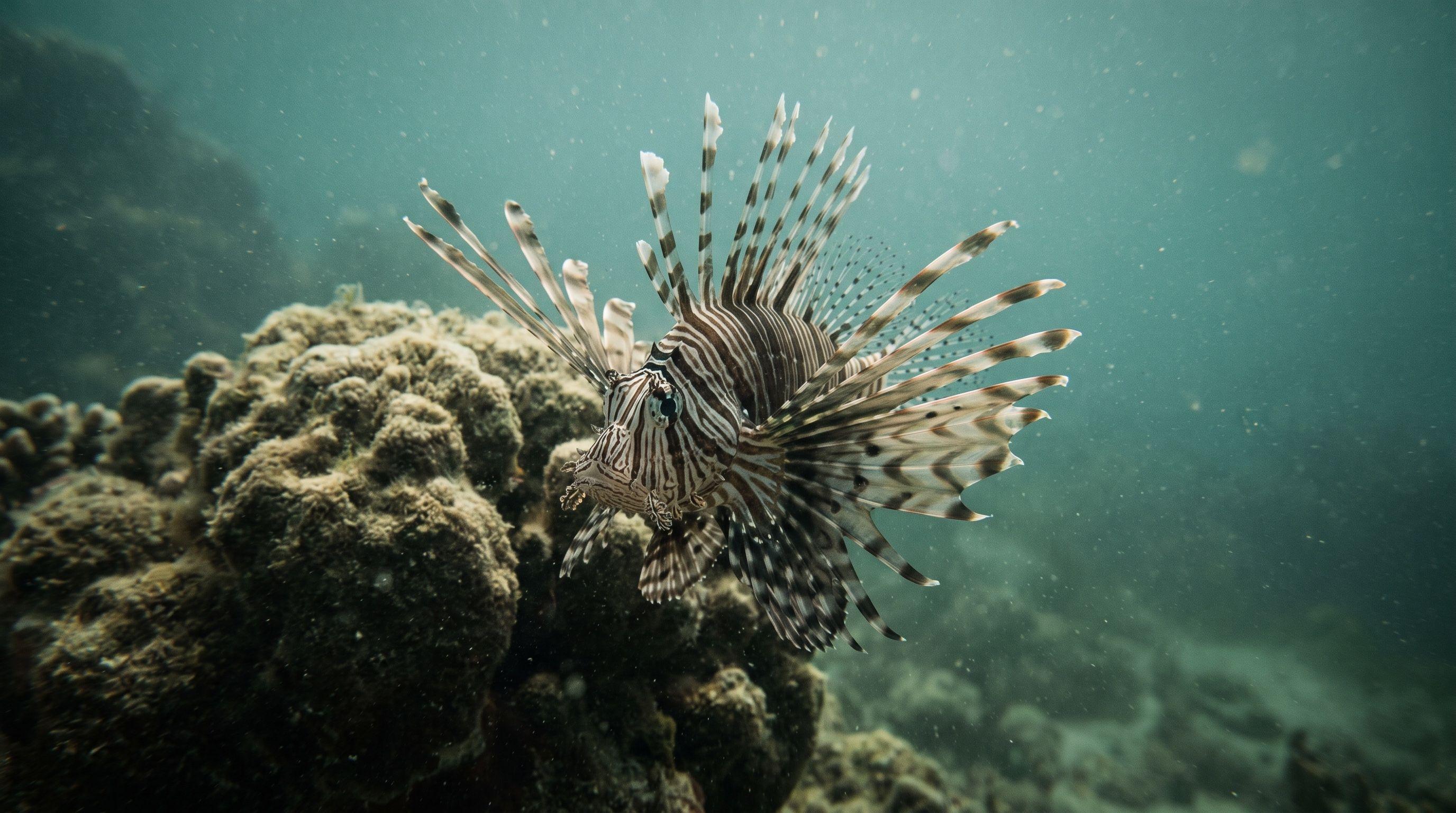 AI-generated
AI-generated illustration
Image credit: AI-generated illustration · License unspecified · Source unspecified