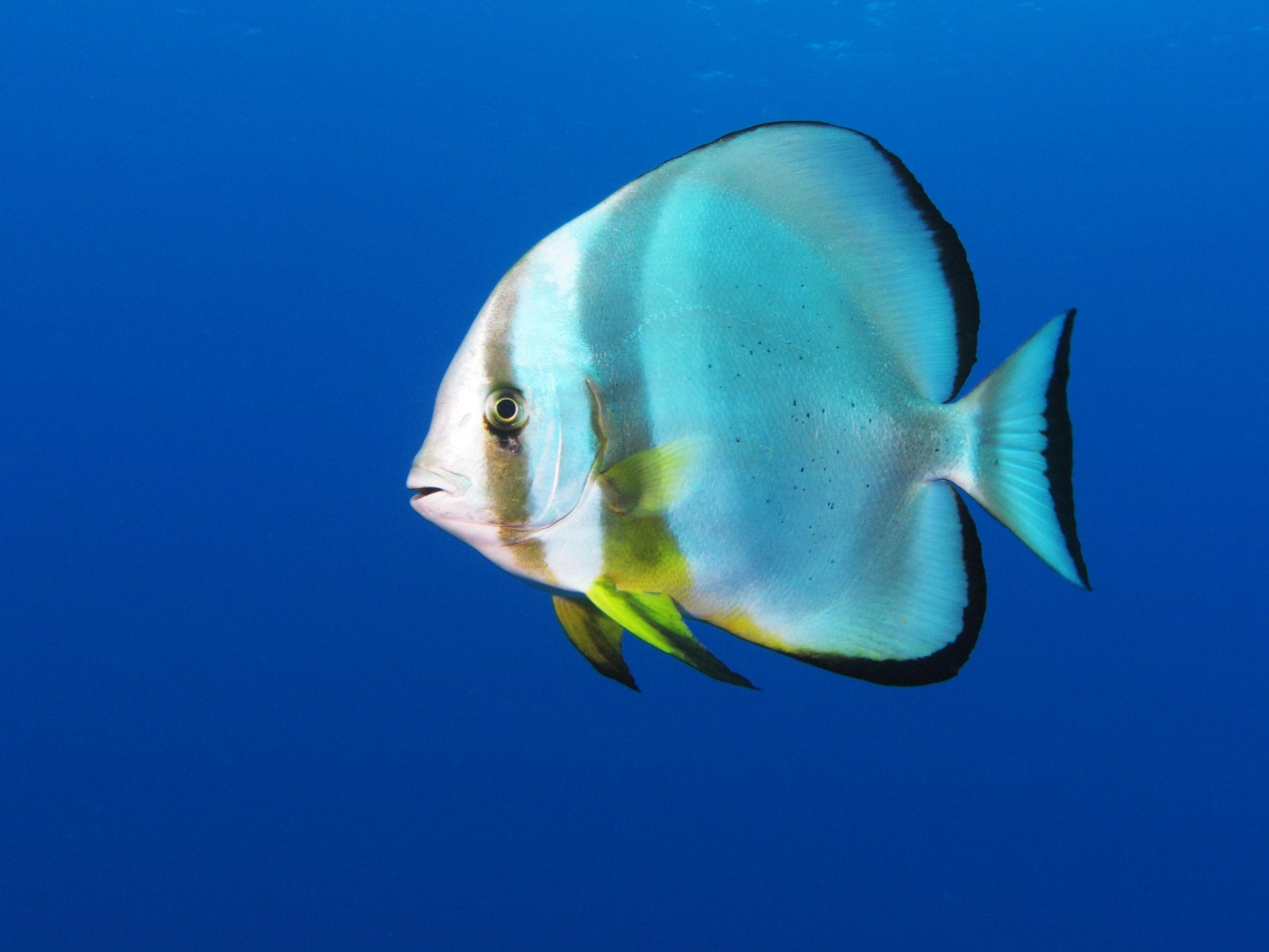
Longfin Batfish
Platax teira
About Longfin Batfish.
The Longfin Batfish, scientifically known as Platax teira, is a striking and often curious inhabitant of tropical and subtropical Indo-Pacific waters. Belonging to the family Ephippidae, which includes spadefish and other batfish species, this fish is a common sight for divers across its extensive range, from the Red Sea and East Africa to Papua New Guinea and Australia.
Known for its calm and inquisitive nature, the Longfin Batfish frequently approaches divers, sometimes even following them throughout a dive. They are highly social, often forming schools that may include individuals of other species, showcasing their peaceful disposition. While adults typically prefer open reef areas, coastal lagoons, and wreck sites, juveniles are often found in shallower waters, including mangrove areas and seagrass beds, where they can mimic floating leaves or debris for camouflage. This species is an omnivore, feeding on a varied diet of algae, plankton, and small invertebrates. With a maximum size of 60 cm (24 in), the Longfin Batfish is currently listed as 'Least Concern' by the IUCN, indicating a stable population. They are typically found at depths of 3–25 m, though they can inhabit deeper reefs up to 70 m, in waters ranging from 24–29°C.
Identification
The Longfin Batfish exhibits distinct physical characteristics that change significantly between its juvenile and adult stages:
- Body Shape: Adults have a highly compressed, disc-shaped body, giving them a rounded profile. Juveniles, however, have a shorter body with exceptionally tall dorsal and anal fins, creating a more elongated, ribbon-like or triangular appearance.
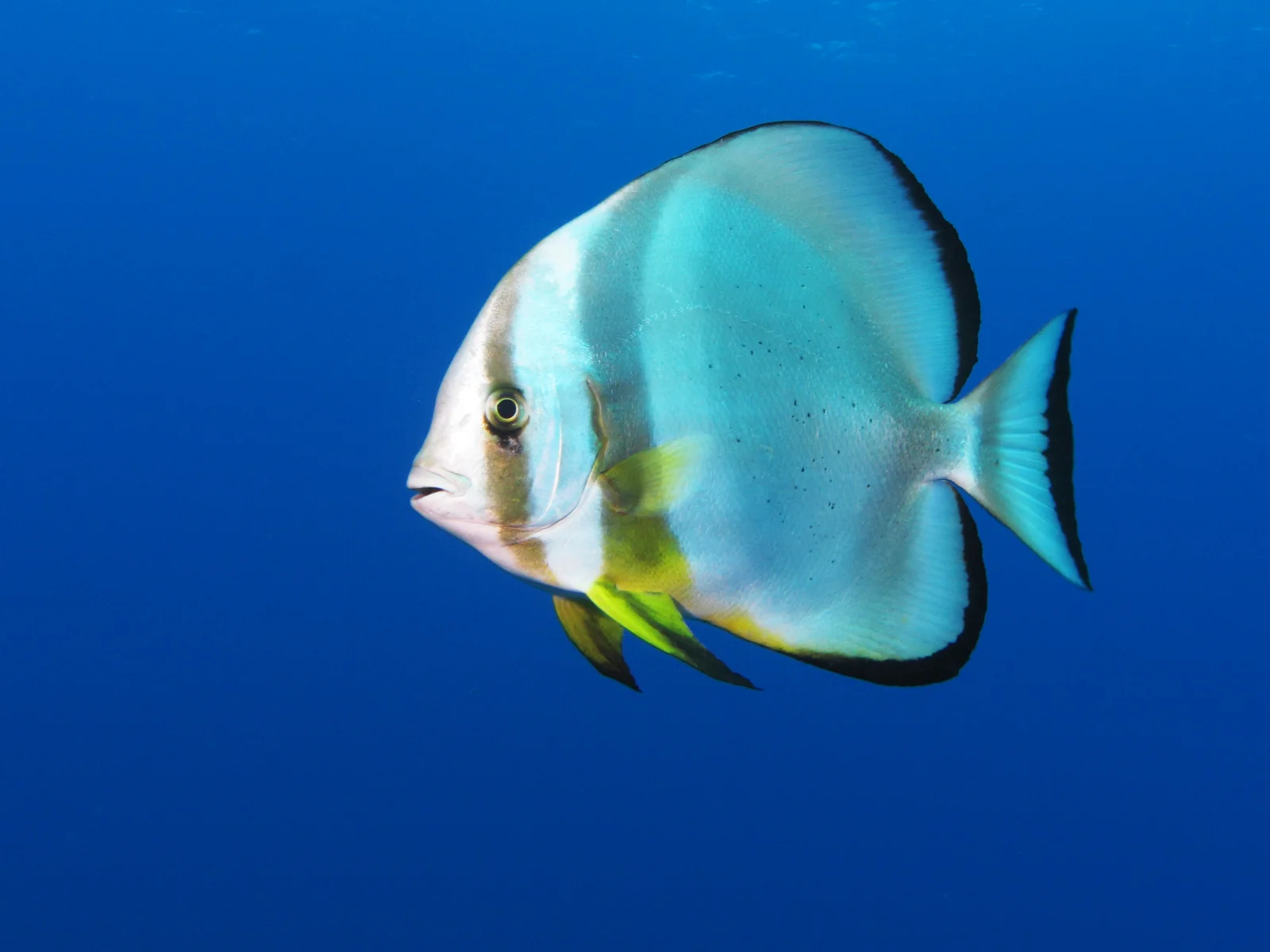
- Coloration: The body is generally silver, grey, or brownish, with adults often displaying faint yellow tinges and dusky vertical bands. They possess a dark band running through the eye and another near the pectoral fin. A distinguishing dark blotch is typically visible below the pectoral fin, with another elongated dark mark above the base of the anal fin. The intensity of these patterns can change rapidly.
- Fins: A key identification marker, especially in juveniles, is their extremely tall, angular dorsal and anal fins. As the fish matures, these fins become relatively shorter, and the body rounds out. Adult fins are often dusky yellow with black margins posteriorly, while juvenile pelvic fins can be yellow.
- Head: Adults may develop a small bony bulge on the forehead, which is absent in juveniles.
- Mimicry: Juvenile Longfin Batfish are masters of camouflage, mimicking floating leaves or debris, and some even resemble toxic flatworms to deter predators. This mimicry, combined with their profound coloration, provides excellent contrast in seagrass beds and among floating debris.
Where it lives.
The Longfin Batfish, Platax teira, is a highly adaptable species found across a wide range of marine environments throughout the tropical and subtropical Indo-West Pacific region. Its distribution spans from the Red Sea and East Africa eastward to Papua New Guinea, extending north to the Ryukyu Islands of Japan, and south to Australia and New Zealand. It has also been reported as an invasive species in the Mediterranean Sea.
This species exhibits distinct habitat preferences between its juvenile and adult stages:
- Adult Habitat: Adult Longfin Batfish are commonly encountered inshore on protected reefs, seaward reefs, and within coastal lagoons. They frequently aggregate around artificial structures such as shipwrecks and other submerged debris, making them a common sight at many dive sites. They can also be found in mangrove areas and deeper offshore reefs. Adults may be observed solitary, in pairs, or forming large schools, sometimes even mingling with other fish species.
- Juvenile Habitat: Juveniles typically inhabit very shallow coastal waters, often seeking refuge in seagrass meadows and mangrove areas, which serve as crucial nursery habitats. They are also known to shelter among floating debris, including large rafts of *Sargassum* seaweed, and near mooring lines, where their distinctive coloration and morphology allow them to mimic floating leaves for camouflage.
Longfin Batfish are generally found at depths ranging from shallow coastal areas down to 70 m. While they can inhabit deeper offshore environments, they are most commonly observed by divers at depths of 3–25 m. They prefer waters with temperatures typically between 22–27°C. The substrate in their preferred habitats often includes sandy or rocky bottoms, as well as coral reefs.
As omnivores, Longfin Batfish play an important ecological role, feeding on a diverse diet of algae, zooplankton, and benthic invertebrates. Their grazing on algae helps prevent overgrowth on coral reefs, contributing to the health of these vital ecosystems. Known for their curious nature, these batfish are often unafraid of divers and may approach them closely.
How it behaves.
Underwater Encounter Behavior
Longfin Batfish are renowned for their calm and curious demeanor, often approaching divers with an engaging presence. They are slow-moving and peaceful, making them excellent subjects for underwater photography. Divers may observe them playing with bubbles or peering through masks. While adults are commonly seen in slow-circling schools, particularly around structures like shipwrecks and reef drop-offs, individuals or pairs also exhibit bold and inquisitive behaviors. Interestingly, some individuals have been noted to be attracted to the color yellow, occasionally following divers wearing yellow fins or wetsuits. Juvenile Longfin Batfish display a remarkable form of mimicry, closely resembling floating leaves or debris to evade predators. They often inhabit very shallow waters, close to the surface, among seagrass beds, mangroves, or marine debris, sometimes flattening their bodies against the surface to enhance their camouflage. As they mature, adults typically transition to deeper environments, preferring open reef areas, coastal lagoons, and seaward reefs. This species is generally encountered at depths of 3–25 m, though they can sometimes be found deeper, up to 30 m or more, in waters of 20–31.4°C.Feeding Habits
The Longfin Batfish is an omnivorous species, adapting its diet to its environment and life stage. Their diet primarily consists of marine algae, plankton, and small invertebrates such as crustaceans and worms. They are also known to graze on sessile invertebrates, including corals and anemones. Juveniles may supplement their diet with detritus and organic debris. Observations of closely related species suggest that *Platax* species may exhibit nocturnal dietary shifts, actively hunting zooplankton during the night, indicating a broader carnivorous component to their omnivorous feeding strategy than previously understood.Social Structure
Longfin Batfish are highly social creatures, frequently forming schools that can range from small groups to impressive aggregations of thousands of individuals. These schools are often observed near prominent underwater features like wrecks or reef walls. It is not uncommon for Longfin Batfish schools to intermingle with other fish species. Juveniles typically form smaller aggregations, often seeking shelter among floating debris. While schooling is a common behavior, individuals can also be encountered swimming alone or in pairs.Notable Seasonal Patterns
Longfin Batfish are a year-round presence in tropical waters, with consistent sightings across their extensive Indo-Pacific distribution. While there isn't extensive information on specific breeding seasonality relevant to divers, it is known that fertilized eggs and larvae drift with ocean currents. Divers may notice a higher prevalence of juveniles in mangrove habitats during the wet season. Furthermore, large schools of adult Longfin Batfish have been observed congregating under substantial rafts of Sargassum seaweed, which typically form after the wet season. Early morning or late afternoon dives often provide optimal lighting conditions for observing their reflective bodies.Where to see it.
Evidence for philippines · 10 dive sites
General range is not evidence of occurrence at a specific dive site.
Alma Jane Wreck
Puerto Galera
Site occurrence not yet documented
Season not yet documented
No dated observations available.
Barracuda Lake (Luluyuan Lake)
Coron
Site occurrence not yet documented
Season not yet documented
No dated observations available.
Cathedral
Anilao
Site occurrence not yet documented
Season not yet documented
No dated observations available.
Daryl Laut (Wreck)
Anilao
Site occurrence not yet documented
Season not yet documented
No dated observations available.
Dry Dock
Puerto Galera
Site occurrence not yet documented
Season not yet documented
No dated observations available.
Kogyo Maru
Coron
Site occurrence not yet documented
Season not yet documented
No dated observations available.
Kyokuzan Maru
Coron
Site occurrence not yet documented
Season not yet documented
No dated observations available.
Masaplod North
Dauin
Site occurrence not yet documented
Season not yet documented
No dated observations available.
Nanshin Maru (Black Island Wreck)
Coron
Site occurrence not yet documented
Documented site seasonality: Mar, Apr, May
No dated observations available.
Okikawa Maru
Coron
Site occurrence not yet documented
Season not yet documented
No dated observations available.
Gallery.