Pygmy Seahorse (assorted)
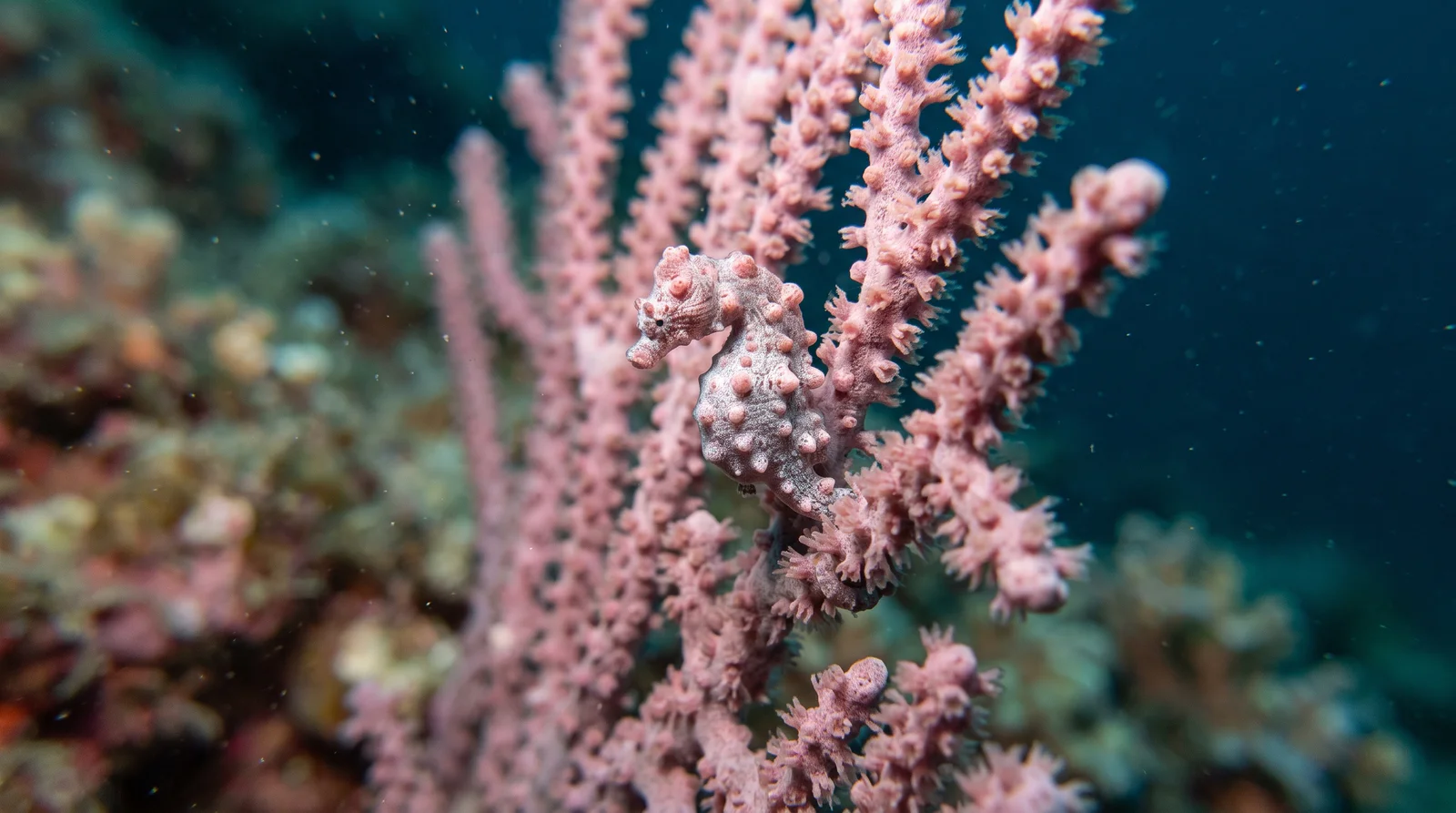 AI-generated
Image credit: AI-generated illustration · License unspecified · Source unspecified
Hippocampus spp. (pygmy seahorses)
About Pygmy Seahorse (assorted).
"Pygmy Seahorse (assorted)" is a group entry for the tiny pygmy seahorses of the genus Hippocampus, used when a sighting or source records a pygmy seahorse without naming the species. Where it can be identified, use the single-species entries for Pygmy Seahorse (Hippocampus bargibanti), Denise's Pygmy Seahorse (H. denise) or Pontoh's Pygmy Seahorse (H. pontohi) instead.
Pygmy seahorses are among the smallest seahorses, at about 14–26 mm standard length. H. bargibanti was the only pygmy species described before 2000; several more have been named since, and a 2018 study that recognised six species from the central Indo-Pacific described a seventh, H. japapigu, from Japan. H. denise was described in 2003 and H. pontohi in 2008. Known records span the Coral Triangle, the western Pacific, Australia and central Japan. Like all seahorses, they belong to the family Syngnathidae, alongside pipefishes and seadragons.
Identification
- Shared features: Pygmy seahorses have a single gill opening rather than paired openings, and the males brood the young on the trunk.
- Gorgonian specialists: H. bargibanti and H. denise live only on gorgonian corals and lack a distinct coronet; H. bargibanti has large bulbous tubercles.
- Free-living species: Most other pygmy species are not tied to a single host and have a distinct coronet; H. pontohi, for example, has a distinct, angular coronet.
- Brood pouch: Mature males of H. bargibanti and H. denise lack an externally obvious brood pouch, so the sexes are hard to tell apart.
- Camouflage: Pygmy seahorses are cryptic; their colour and texture resemble their surroundings, which is why they are easily overlooked.
Conservation
Pygmy seahorses belong to the genus Hippocampus, which is listed in CITES Appendix II as a whole; the listing took effect on 15 May 2004. IUCN Red List categories vary by species, so check the single-species entries for individual assessments.
Where it lives.
Pygmy seahorses live in the Indo-Pacific, with known records across the Coral Triangle, the western Pacific, Australia and central Japan. They are reef animals that depend closely on the organisms they cling to. Six species had been recognised from the central Indo-Pacific before H. japapigu was described from central Japan in 2018.
Habitat associations reported for the group include:
- Gorgonian sea fans: H. bargibanti and H. denise are found only on gorgonian corals, where they hold on to the branches with their tails.
- Hydroids, bryozoans and other octocorals: Free-living species are associated with colonial hydrozoans, bryozoans and octocorals.
- Seagrass and algae: Some pygmy seahorses are also associated with seagrass and algae.
Depth records vary by species. H. japapigu, for example, was collected at 10–13 m and has been reported by local divers at 5–22 m. The references consulted for this entry do not give a single depth range for the group, so treat depth information as species-specific. Because new species have been described repeatedly since 2000, the known range of the group may still change.
Because pygmy seahorses are tiny and closely match their hosts, finding one usually depends on knowing which host to check. Gorgonian-dwelling species are found on sea fans, while free-living species may be anywhere among the hydroids, algae and other soft growth of the reef. Searching slowly and checking the surfaces of likely hosts is more productive than scanning the open reef, and good buoyancy keeps fins and equipment clear of the fragile hosts while you look.
How it behaves.
Pygmy seahorses spend most of their time gripping their host with their tails and rely on camouflage rather than movement to avoid detection. Their colour and surface texture blend in with their surroundings, so they are cryptic and easy to miss.
Reproduction
As in other seahorses, the male carries the young; in pygmy seahorses the brood is held on the trunk. In the gorgonian-dwelling H. bargibanti and H. denise, the male's brood pouch is not obvious from outside, so males and females are hard to tell apart underwater.
Seahorse lifespans are estimated, mostly from laboratory observation, at about one year in the very small species and three to five years in larger ones. Predation is probably greatest among juveniles, which are eaten by many fishes and invertebrates.
Underwater Encounter Behavior
Because they stay on one host and are very small, pygmy seahorses cannot easily move away from a diver or a camera, so keeping disturbance low is the observer's responsibility. Handling live seahorses should be avoided because it is likely to cause injury or death, and contact can also damage the host coral or hydroid. Repeated close approaches by several divers add to the disturbance.
Diver Tips
The following points are general good practice rather than findings from a specific study:
- No touching: Do not touch the seahorse or its host, and never move a pygmy seahorse for a photograph.
- No prodding: Do not push or tap the host to turn a seahorse towards the camera.
- Limit strobe and focus-light use: Take only a few photographs, keep focus lights dim and give the animal breaks between shots.
- Keep good buoyancy: Hover clear of the reef so that fins, gauges and camera housings do not touch the host.
- Take turns: When several divers want to see the same animal, short turns reduce the time it spends under lights.
Where to see it.
Evidence for boracay · 2 dive sites
General range is not evidence of occurrence at a specific dive site.
Camia II Wreck
Boracay
Documented site occurrence
Season not yet documented
Source reviewed on 2026-10-14 · Source: Wicked Squid Divers Boracay (Wayback snapshot 2026-03-12 of /boracay-dive-sites/) · Observation date not documented
Crocodile Island
Boracay
Documented site occurrence
Season not yet documented
Source reviewed on 2026-10-14 · Source: Wicked Squid Divers Boracay (Wayback snapshot 2026-03-12 of /boracay-dive-sites/) · Observation date not documented
Gallery.
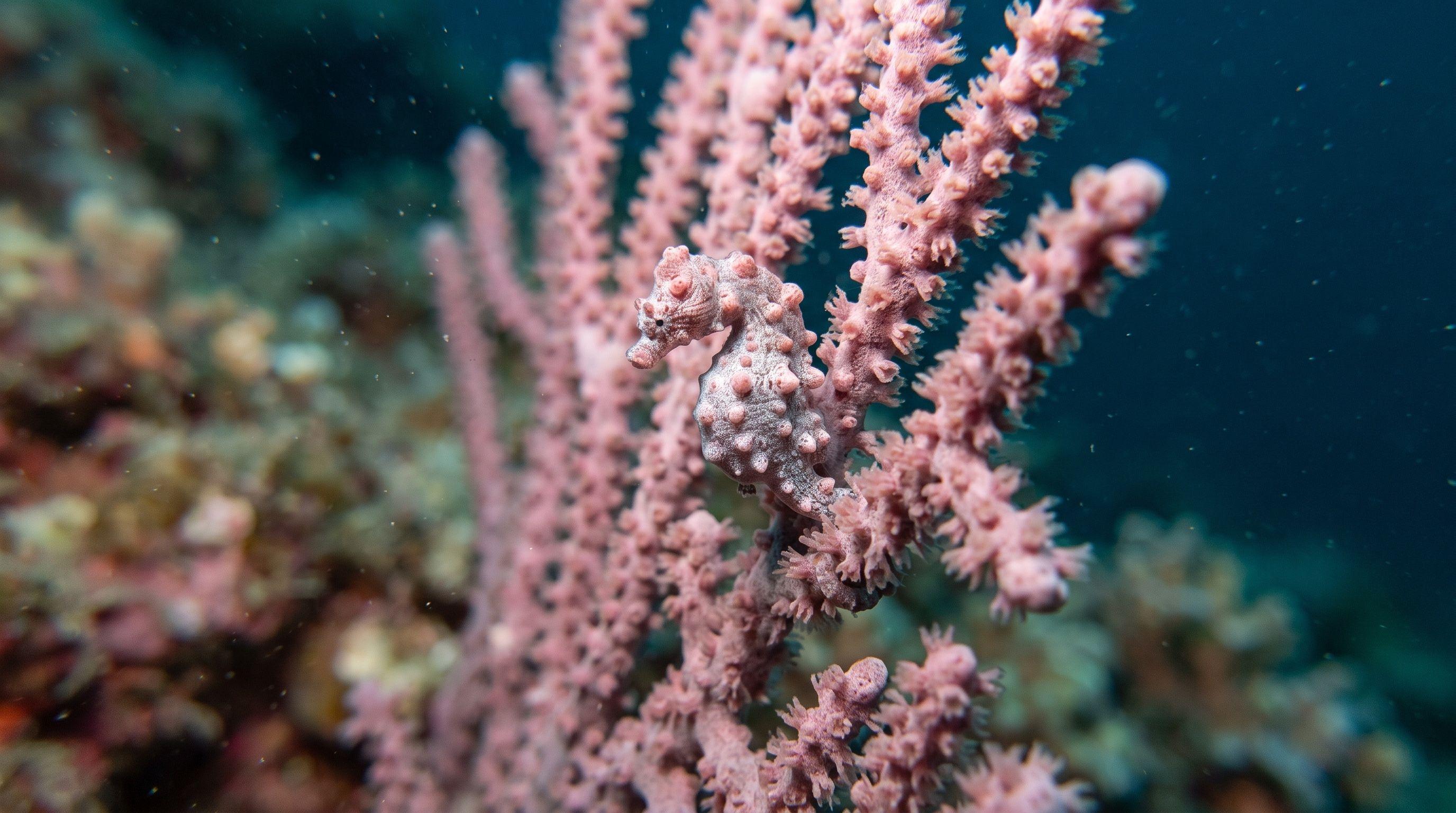 AI-generated
AI-generated illustration
Image credit: AI-generated illustration · License unspecified · Source unspecified