Scorpionfish (assorted)
 AI-generated
Image credit: AI-generated illustration · License unspecified · Source unspecified
Scorpaenidae spp.
About Scorpionfish (assorted).
Scorpionfishes (family Scorpaenidae) are bottom-dwelling, mostly marine fishes; the Florida Museum of Natural History notes that the family includes many of the world's venomous fishes. This group entry covers scorpionfish sightings where the species was not recorded. Diveity also has individual pages for many species, including the Bearded, Devil, Papuan, Leaf, Ambon, Weedy and Spotted scorpionfishes. Lionfishes also belong to Scorpaenidae (subfamily Pteroinae in WoRMS) but have their own group entry on Diveity.
Stonefishes are close relatives that are easily confused with scorpionfishes. FishBase, the World Register of Marine Species (WoRMS) and the Australian Museum all place them in a separate family, Synanceiidae, so they are not the focus of this entry, although some older guides group them with the scorpionfishes.
Identification
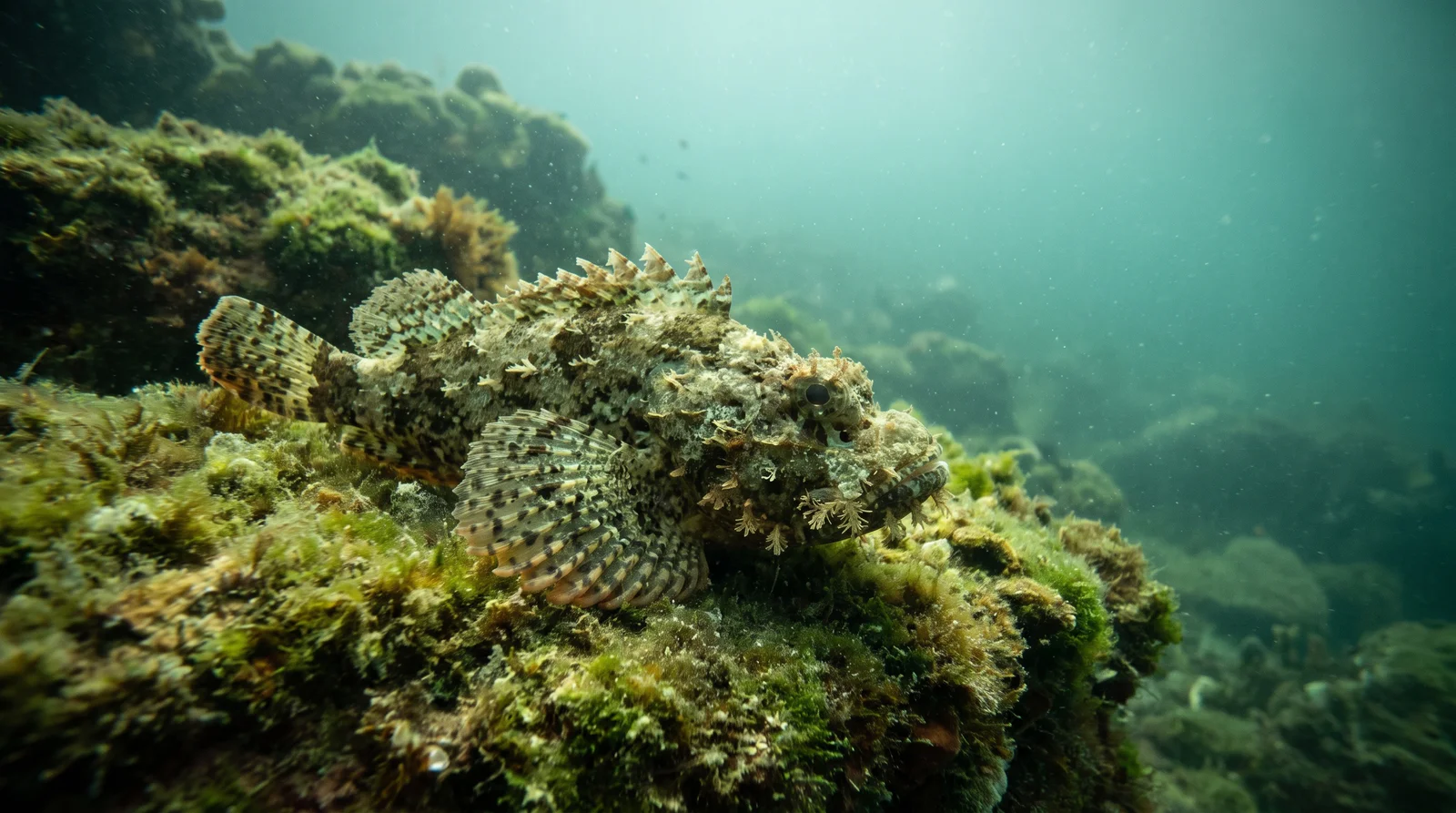
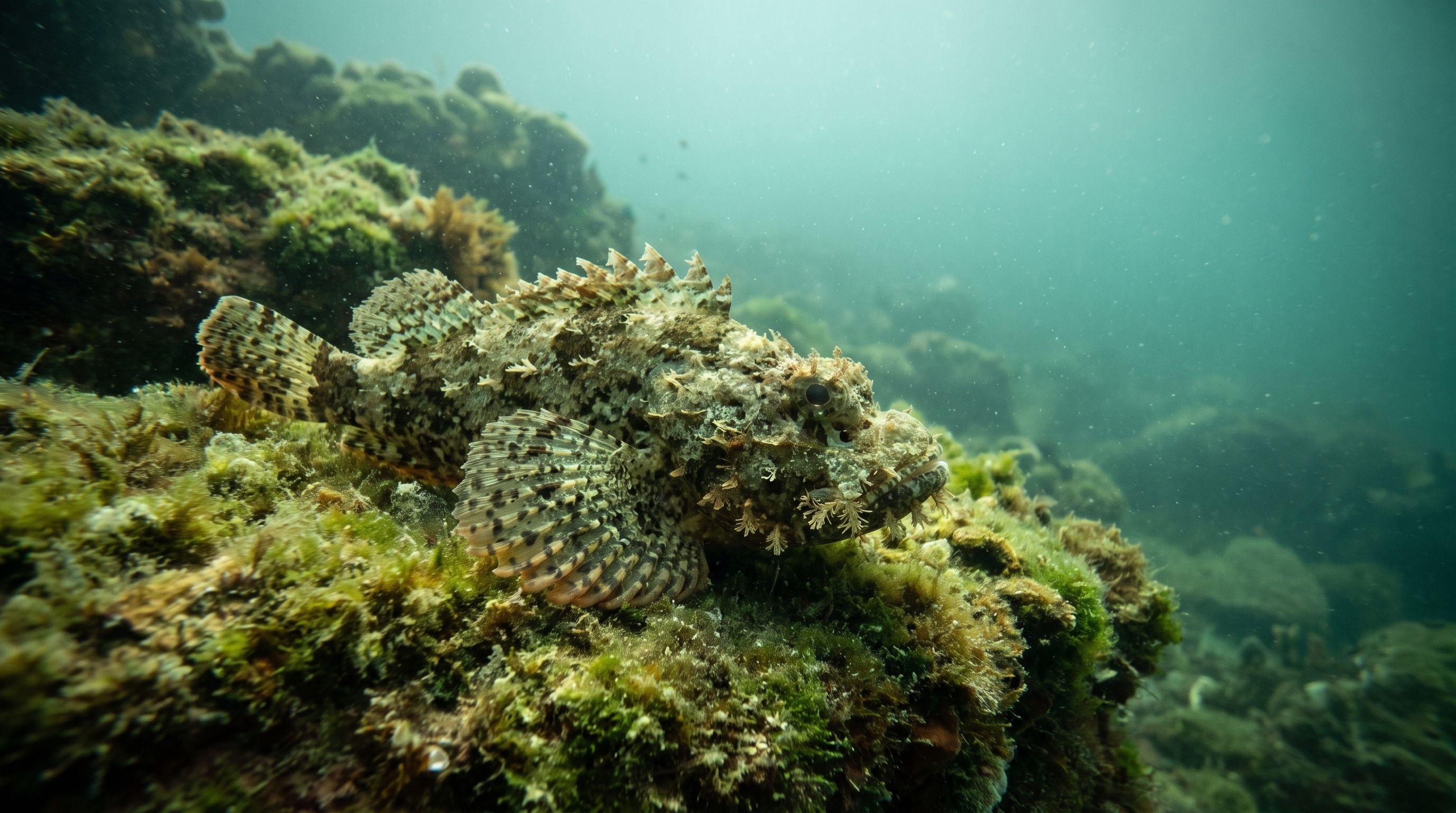
- Camouflage: Mottled colour and textured skin. The Florida Museum describes fleshy plumes (cirri) over the eyes and skin flaps around the chin and head of the Spotted Scorpionfish (Scorpaena plumieri), and FishBase describes adult Tassled Scorpionfish (Scorpaenopsis oxycephala) as bearded with numerous tassels and highly variable in colour.
- Shape: A large head and wide mouth on a stout body that often rests motionless on the bottom.
- Size: FishBase gives a maximum length of 36 cm for S. oxycephala; the Florida Museum gives a maximum of 45 cm for S. plumieri, which is usually about 18–36 cm long.
- Spines: The Florida Museum notes that venom glands are associated with the dorsal fin spines of S. plumieri.
Conservation status varies by species. FishBase reports an IUCN Red List assessment of Least Concern for S. oxycephala (assessed in 2015), and the Florida Museum states that S. plumieri is not listed as endangered or vulnerable by the IUCN. The Florida Museum also reports at least one case of ciguatera poisoning from eating Spotted Scorpionfish in the Virgin Islands.
Where it lives.
Scorpionfishes are bottom-dwelling fishes of coral and rocky reefs. FishBase describes the Tassled Scorpionfish across the Indo-West Pacific, from the Red Sea and South Africa to the Mariana Islands and north to Taiwan, on clear-water outer reef slopes and channels with mixed rock and coral. The Florida Museum describes the Spotted Scorpionfish near shallow coral reefs and rocky areas, where it typically lies motionless on the bottom. FishBase notes that the Tassled Scorpionfish is probably more widespread than its documented range.
Where Divers Find Them
- Depth: FishBase records S. oxycephala from 1 m to at least 35 m, and the Florida Museum gives 5–55 m for S. plumieri.
- Substrate: On coral, rock and rubble, often on ledges, coral heads and other hard surfaces where their colouring matches the background.
- Varied preferences: Species differ: some favour exposed outer slopes, others sheltered sand and rubble; the individual species pages give details.
- Stonefish nearby: FishBase describes the Reef Stonefish (Synanceia verrucosa, family Synanceiidae) on sand or rubble of reef flats and shallow lagoons at 0–30 m, from the Red Sea and East Africa to French Polynesia, sometimes covered with algae, which is a reason to watch where you put your hands and knees in shallow water.
Scorpionfishes are easy to overlook. Slow, careful scanning of reef surfaces, looking for an eye, the outline of a mouth or the edge of a fin, is the most reliable way to find them. A torch can help reveal their outline and colours, even on daytime dives.
How it behaves.
Scorpionfishes are ambush predators. The Florida Museum explains that the Spotted Scorpionfish uses its mottled colouring and texture to get within striking distance of smaller fishes and crustaceans, then opens its large mouth to create a vacuum and swallow the prey. FishBase describes the Tassled Scorpionfish as solitary on coral and rocky bottoms.
Underwater Encounter Behavior
Most scorpionfishes rely on staying still. Divers often notice one only when it shifts a short distance or a fin moves. Because they depend on camouflage rather than swimming away, they may allow a close approach, which also makes accidental contact more likely. The Florida Museum notes that the venom in the dorsal spines deters predators and humans and is released when the spines penetrate skin. The Florida Museum lists the diet of the Spotted Scorpionfish as mainly other fish and crustaceans, and FishBase notes that the Reef Stonefish is likewise solitary and well camouflaged and feeds on fishes and crustaceans.
Diver Tips
- Venomous spines: FishBase lists S. oxycephala as venomous to humans. The Florida Museum notes that the venom of the Spotted Scorpionfish is not generally fatal but that victims should get immediate medical treatment.
- Stonefish risk: FishBase describes Reef Stonefish stings as excruciatingly painful and occasionally fatal, and notes that antivenom is effective if given immediately after the sting.
- Buoyancy: Avoid touching, kneeling on or resting on the reef, because any patch of rock may hide a scorpionfish; the same applies to placing a pointer or reef hook.
- Photography: Do not prod or move a scorpionfish for a better angle; reposition yourself instead and keep your fins clear of the bottom.
- Learn the shape: Practise spotting the eye and the outline of the mouth; once you recognise the shape, scorpionfishes become much easier to find without touching anything.
- If stung: Leave the water safely, tell your dive leader and get medical help.
Where to see it.
Evidence for philippines · 12 dive sites
General range is not evidence of occurrence at a specific dive site.
Angol Point
Boracay
Documented site occurrence
Season not yet documented
Source reviewed on 2026-10-14 · Source: New Wave Divers Boracay (dive-site page) · Observation date not documented
Camia II Wreck
Boracay
Documented site occurrence
Season not yet documented
Source reviewed on 2026-10-14 · Source: New Wave Divers Boracay (dive-site page) · Observation date not documented
Coral Garden
Davao Gulf
Documented site occurrence
Season not yet documented
Source reviewed on 2026-10-14 · Source: ScubaBoard trip report "Talicud Island (Davao, PI)" (single diver) · Observation date not documented
Friday's Rock
Boracay
Documented site occurrence
Season not yet documented
Source reviewed on 2026-10-14 · Source: New Wave Divers Boracay (dive-site page) · Observation date not documented
Habok Habok
Sipalay
Documented site occurrence
Season not yet documented
Source reviewed on 2026-10-14 · Source: Diving Squad, "Sipalay Diving" guide (single-author first-person review) · Observation date not documented
Julien's Wreck
Sipalay
Documented site occurrence
Season not yet documented
Source reviewed on 2026-10-14 · Source: Sea Explorers Sipalay, "Sipalay Dive Sites" page · Observation date not documented
Laguna
Boracay
Documented site occurrence
Season not yet documented
Source reviewed on 2026-10-14 · Source: New Wave Divers Boracay (dive-site page) · Observation date not documented
Mansud Wall
Davao Gulf
Documented site occurrence
Season not yet documented
Source reviewed on 2026-10-14 · Source: PADI dive-site page (contributor: South Shore Divers) · Observation date not documented
MS Jojo
Sipalay
Documented site occurrence
Season not yet documented
Source reviewed on 2026-10-14 · Source: Artistic Diving & Beach Resort, dive-sites page (Wayback snapshot 2019-10-21) · Observation date not documented
Talima Marine Sanctuary
Mactan
Documented site occurrence
Season not yet documented
Source reviewed on 2026-10-14 · Source: Bohol-Philippines.com, Olango Island dive sites (Polaris Dive Center text; Wayback snapshot 2024-11-08) · Observation date not documented
Tambuli
Mactan
Documented site occurrence
Season not yet documented
Source reviewed on 2026-10-14 · Source: 7 Seas Dive Center Cebu, dive sites page (Wayback snapshot 2024-06-14) · Observation date not documented
Tribird
Boracay
Documented site occurrence
Season not yet documented
Source reviewed on 2026-10-14 · Source: New Wave Divers Boracay (dive-site page) · Observation date not documented
Gallery.
 AI-generated
AI-generated illustration
Image credit: AI-generated illustration · License unspecified · Source unspecified