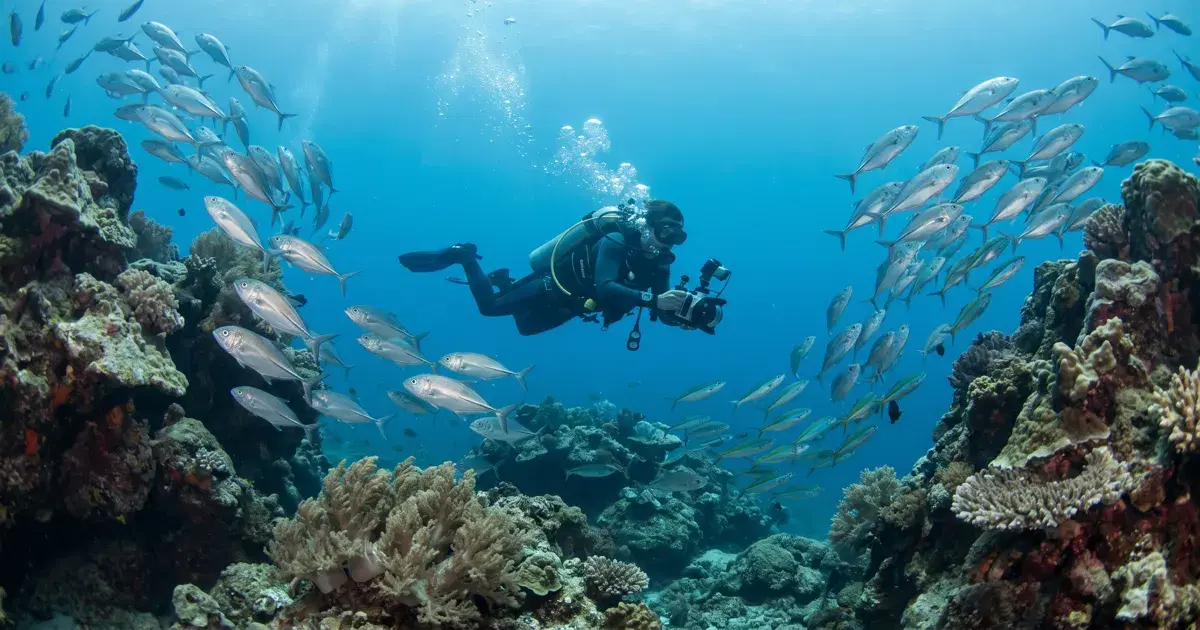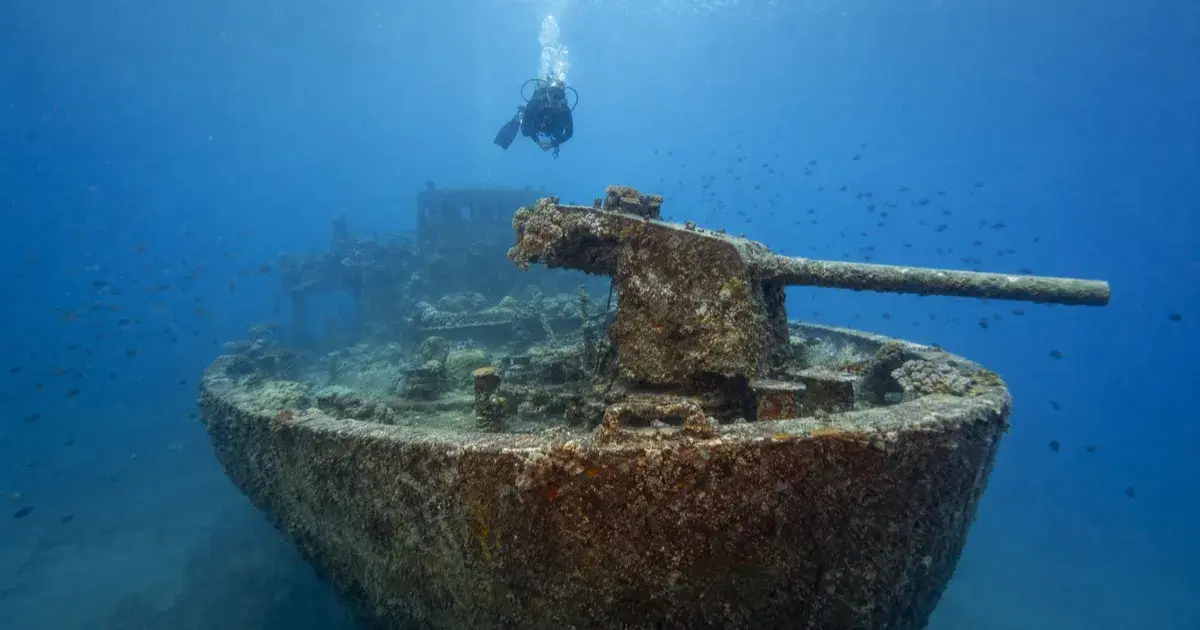
The SS Thistlegorm in Egypt's Red Sea, the SS Yongala in Australia and the SS President Coolidge in Vanuatu are three of the ten wrecks in this guide, which also takes in Bali, Chuuk, the Philippines, Cyprus, Florida, Malta and Canada. According to Wikipedia, The Times named the Thistlegorm, the Zenobia and the Fujikawa Maru among the world's top ten wreck dives.
How Was This List Put Together?
The ten wrecks are listed, not ranked. Each section names the source of every figure it gives: Diveity's own dive-site records where they carry sources, and otherwise the pages named in the section, such as Wikipedia or a park or museum page. Where none of them documents a depth, level, current or season for a wreck, the section says so; confirm those with the operator before you dive. Two famous wrecks that are not on the list, the HMHS Britannic and the Andrea Doria, are covered separately near the end.
Which Ten Wrecks Are on the List?
SS Thistlegorm, Egypt
The Thistlegorm was a British freighter armed with an anti-aircraft gun and a machine gun. The Thistlegorm Project says two bombs from a German aircraft struck her early on 6 October 1941 at Safe Anchorage F near the Straits of Gubal, and that the ammunition in her hold exploded and tore her in two. Her cargo, bound for Alexandria and the Allied forces in Egypt, included trucks, Universal Carrier armoured vehicles, Norton and BSA motorcycles and two steam locomotives carried on deck, which the explosion threw off to either side of the wreck. The project lists the trucks as Leyland, Albion and Morris Commercial; Wikipedia lists Bedford trucks. Jacques Cousteau found the wreck in the early 1950s with information from local fishermen, and the project now records its remains in an archaeological survey.
The Thistlegorm Project gives about 32 m at the deepest point of the wreck, and Wikipedia about 30 m. Both say that depth is ideal for diving without the need for specialist equipment and training, and Wikipedia also mentions strong currents in the area. Diveity's record for the site carries no sources yet, so a deck depth, a certification level and a best season are not documented in it; ask the operator what the planned dive requires.
SS Yongala, Australia
The Yongala was a passenger steamship that sank in a cyclone off the Queensland coast on 23 March 1911 with everyone aboard, according to Wikipedia, which puts the number at no fewer than 122. The Queensland Museum gives 109 m and 122 people, and says the wreck was not found until 1958. Wikipedia places the 109 m wreck about 48 nautical miles south-east of Townsville, listing to starboard, with its upper parts at 16 m and the sea floor at about 30 m. It describes diverse marine life, with the humphead wrasse the species most often recorded in a citizen-science database.
Wikipedia says the wreck is protected by the Commonwealth Underwater Cultural Heritage Act 2018, which prohibits penetration diving and interference with artefacts, and that access to its protected zone is by permit only. Diveity's record for the site carries no sources yet, so current, a certification level and a best season are not documented here. Diveity has a Yongala dive site page and a Yongala guide.
SS President Coolidge, Vanuatu
The Coolidge was a luxury ocean liner completed in 1931 and later used as a troopship. On 26 October 1942 she struck two American mines while entering the harbour of Espiritu Santo; the mines had been left out of her sailing orders, as a US National Archives blog post describes alongside photographs of the sinking. Wikipedia says 5,340 men got ashore over the next 90 minutes, many of them walking, while the National Archives gives roughly 5,000; both say two men died. Wikipedia gives her length overall as 653 ft (about 199 m).
According to Wikipedia, the wreck rests on her port side on a slope, with the bow at about 21 m and the stern at about 73 m, and divers see guns, Jeeps, helmets and "The Lady", a porcelain relief. It says recreational divers can explore large parts of the wreck with care and decompression stops, and warns that on the gradual slope a diver can lose track of the continuing descent. Diveity's record for the site carries no sources yet, so a certification level and a best season are not documented here. See also our Coolidge wreck guide and the site page.
USAT Liberty, Bali
The Liberty lies off Tulamben beach in north-east Bali: about 40 m from the beach according to Wikipedia and Blue Season Bali, and about 30 m according to Neptune Scuba Diving. Diveity's record for the site gives the stern at about 5 m and the bow at 28 to 30 m. Wikipedia says she was torpedoed on 11 January 1942 by the submarine I-66, while Wannadive.net and Neptune Scuba Diving name I-166, and that she was run aground at Tulamben and slid off the beach in the tremors of Mount Agung's eruption in 1963.
Diveity's record shows the level as disputed. Wannadive.net, Dive Concepts and Blue Season Bali say divers of all levels can see parts of the wreck, while Neptune Scuba Diving sets Open Water as the minimum for the shallower half and strongly recommends Advanced Open Water for the bow. Neptune Scuba Diving says a school of bumphead parrotfish moves over the wreck at first light from about May to October, and Wannadive.net says the site is very crowded from 10:00 to 14:00. Neptune links the deaths recorded on the wreck to divers going further into the structure than the open swim-throughs, diving below their certified depth or losing control of an ascent. Start with the USAT Liberty site page; see also our Liberty wreck guide and Tulamben diving guide.
Fujikawa Maru, Chuuk Lagoon, Micronesia
Operation Hailstone, a US Navy air and surface attack on Truk Lagoon (now Chuuk) on 17 and 18 February 1944, caught many Japanese merchant ships at anchor, according to Wikipedia. The Fujikawa Maru, a cargo ship the Imperial Japanese Navy used as an armed aircraft transport, sank on 18 February. Wikipedia says at least nine disassembled Mitsubishi fighter aircraft lie in one of her forward holds, eight of them A6M Zeros, and that she still carries a 6-inch bow gun. No depth, level, current or season for the wreck is documented here, and Diveity has no record for it yet.
Okikawa Maru, Coron, Philippines
The Okikawa Maru is a tanker wreck in Coron Bay. CombinedFleet, in its record of her movements, says US carrier aircraft attacked the anchorage at Coron Bay on 24 September 1944, set her afire and sank several other ships, and that a second raid on 9 October finished off her hulk; it also notes that some doubt remains about which tanker the wreck is. Dive3D's photographic model, cited in Diveity's record for the site, gives her as 161 m long.
Diveity's record gives the deck at 10 to 16 m, from Pirates Diving Resort, and shows the maximum depth as disputed: 26 m from MDI Divers and Pirates, 25 m from the Two Seasons Pawikan menu, and 38 m in a table of Sangat Island Dive Resort whose own prose gives 10 to 26 m. Pirates warns of tidal current. The record does not establish a certification level, a difficulty or a season, so ask the operator what the planned dive requires. The Okikawa Maru site page has the details; see also our Coron wreck diving guide.
MS Zenobia, Cyprus
The Zenobia was a Swedish-built roll-on/roll-off ferry on her maiden voyage, which began on 4 May 1980. According to Wikipedia she capsized and sank in Larnaca Bay, about 1,500 m from the shore, on 7 June 1980, taking down the 104 tractor-trailers she carried, and no one died. She rests on her port side in about 42 m of water. Wikipedia describes dives ranging from a fairly simple dive to 16 m along the starboard side, which it calls suitable for newly qualified divers, to dives inside the lower car deck or the engine room, which it says suit only very experienced divers. No current or season is documented here, and Diveity has no record for the wreck yet.
USS Spiegel Grove, Florida, USA
The Spiegel Grove was a US Navy dock landing ship 510 ft (about 155 m) long, sunk as an artificial reef off Key Largo. According to Wikipedia she sank early, on 17 May 2002, and came to rest upside down; she was rolled onto her starboard side in June 2002, and Hurricane Dennis shifted her upright in July 2005. Wikipedia gives her top deck at about 60 ft (18 m) below the surface and her hull at up to 135 ft (about 41 m), says silt inside can reduce visibility to almost zero, and says the depth requires an advanced certification. Three divers died there in 2007 attempting a penetration dive. Diveity has no record for the wreck yet, and no season is documented here.
Um El Faroud, Malta
Um El Faroud was a Libyan-owned tanker. Wikipedia says an explosion during maintenance in a Malta dry dock on 3 February 1995 killed nine shipyard workers, and that after three years in the harbour of Valletta it was decided in 1998 to scuttle her as an artificial reef. The 115 m wreck sits upright on sand southwest of Wied iż-Żurrieq at 36 m, with the top of the bridge at 18 m and the main deck at 25 m; a plaque on the wreck commemorates the explosion. No certification level, current or season is documented here, and Diveity has no record for the wreck yet.
Sweepstakes, Tobermory, Canada
The Sweepstakes is a two-masted wooden schooner built in Burlington, Ontario, in 1867. She was damaged off Cove Island and towed to Big Tub Harbour, where she sank in September 1885. Parks Canada says her hull is still intact, with the windlass and part of the bow rail in place, that she lies in Fathom Five National Marine Park at a maximum depth of 7 m, and that divers, snorkelers and tour-boat passengers visit her; Wikipedia gives 6.1 m. Parks Canada permits no penetration of the wreck, for conservation and safety reasons, and from the Victoria Day weekend in May to the Thanksgiving weekend in October divers reach the Big Tub Harbour wrecks on a schedule and must register first. No certification level or water temperature is documented here.
Which Wreck Dives Can Beginners Do?
That is not settled for most of these wrecks. Diveity's records show the level as disputed for the USAT Liberty and unknown for the Okikawa Maru, Wikipedia says the Spiegel Grove's depth requires an advanced certification and calls the Zenobia's 16 m starboard-side dive suitable for newly qualified divers, The Thistlegorm Project and Wikipedia say the Thistlegorm's depth needs no specialist equipment or training, Wikipedia says recreational divers can explore large parts of the Coolidge with care and decompression stops, and no level is documented here for the others. Ask an operator which part of the wreck the planned dive covers and what it requires.
Wreck | Depth in the sources | Level | Going inside |
|---|---|---|---|
SS Thistlegorm | About 30 m (Wikipedia) to 32 m (The Thistlegorm Project) at the deepest | No specialist equipment or training needed for that depth (both sources) | Cargo visible in Holds No. 1 and 2 (Wikipedia) |
SS Yongala | Upper parts 16 m, sea floor about 30 m (Wikipedia) | Not documented | Prohibited by law (Wikipedia) |
SS President Coolidge | Bow about 21 m, stern about 73 m (Wikipedia) | Recreational divers can explore large parts without specialized equipment, with care and decompression stops (Wikipedia) | Divers swim through holds and decks (Wikipedia) |
USAT Liberty | Stern about 5 m, bow 28–30 m (Diveity record) | Disputed (Diveity record) | Open swim-throughs; Neptune Scuba Diving links deaths to going further in |
Fujikawa Maru | Not documented | Not documented | Not documented |
Okikawa Maru | Deck 10–16 m; maximum disputed, 25–38 m (Diveity record) | Not established (Diveity record) | Not established; the record says compartment descriptions are not entry instructions |
MS Zenobia | 16 m on the starboard side to about 42 m (Wikipedia) | 16 m starboard-side dive suitable for newly qualified divers (Wikipedia) | Lower car deck and engine room only for very experienced divers (Wikipedia) |
USS Spiegel Grove | Top deck about 60 ft (18 m), hull up to 135 ft (about 41 m) (Wikipedia) | Advanced certification (Wikipedia) | Three divers died on a penetration dive in 2007 (Wikipedia) |
Um El Faroud | Bridge 18 m, main deck 25 m, seabed 36 m (Wikipedia) | Not documented | Possible into the engine room and several smaller rooms (Wikipedia) |
Sweepstakes | Up to 7 m (Parks Canada) | Not documented | Not permitted (Parks Canada) |
Going inside any wreck means diving in an overhead environment. Ask the operator what training the planned dive requires.
When Should You Dive Each Wreck?
Diveity's records document a season for one of these wrecks: Neptune Scuba Diving, a single source, calls April to October the peak season at the USAT Liberty. The Okikawa Maru's record leaves its season unknown, and the other wrecks' records carry no sources or do not exist yet, so no season is given here for them. At the Sweepstakes, Parks Canada's scheduled diver access runs from the Victoria Day weekend in May to the Thanksgiving weekend in October. Confirm conditions with a local operator before booking flights.
Which Famous Wrecks Didn't Make the List?
The HMHS Britannic and the Andrea Doria. The Britannic, the Titanic's younger sister, sank after striking a mine near the Greek island of Kea on 21 November 1916 and lies in about 400 ft (about 122 m) of water, according to Wikipedia. Divers Alert Network describes it as a dive for experienced technical divers that needs permission from the wreck site's British owner and permits from the Greek government. Wikipedia says the top of the Andrea Doria's wreck lay at first in 27 fathoms (about 49 m) of water and, as the wreck slowly collapses, is now at about 58 m, that at least 22 scuba divers have lost their lives on it, and that strong currents and heavy sediment that can reduce visibility to zero make the site treacherous; it is commonly called the "Mount Everest of scuba diving".
FAQ
Do You Need a Wreck Certification for These Dives?
The level each wreck needs is documented for only some of them; see the table above. Going inside a wreck is overhead-environment diving, so ask the operator what training the planned dive requires before you go in.
What Is the Deepest Wreck on This List?
Of the depths the sources give for the ten wrecks on the list, the SS President Coolidge's stern is the deepest, at about 73 m according to Wikipedia. No depth is documented here for the Fujikawa Maru.
Are Artificial Reefs Like the Spiegel Grove Real Wreck Dives?
The Spiegel Grove and Um El Faroud were both sunk as artificial reefs, according to Wikipedia. Wikipedia also says the Spiegel Grove's hull is a labyrinth inside, where silt can reduce visibility to almost zero and cause disorientation, and that three divers died there in 2007 attempting a penetration dive.
Can You Snorkel Any of the Best Wrecks?
Parks Canada says the Sweepstakes is visited by snorkelers as well as divers. Snorkelling at the other wrecks is not documented here.
Why Is Penetration Banned on Some Wrecks?
For the Yongala it is the law: Wikipedia says the Underwater Cultural Heritage Act 2018 prohibits penetration diving and interference with artefacts there. For the Sweepstakes, Parks Canada gives conservation and safety as its reasons.
Plan Your Wreck Trip With Diveity
Five of these ten wrecks have pages in the Diveity dive-site atlas: the SS Thistlegorm, the SS Yongala, the SS President Coolidge, the USAT Liberty and the Okikawa Maru.