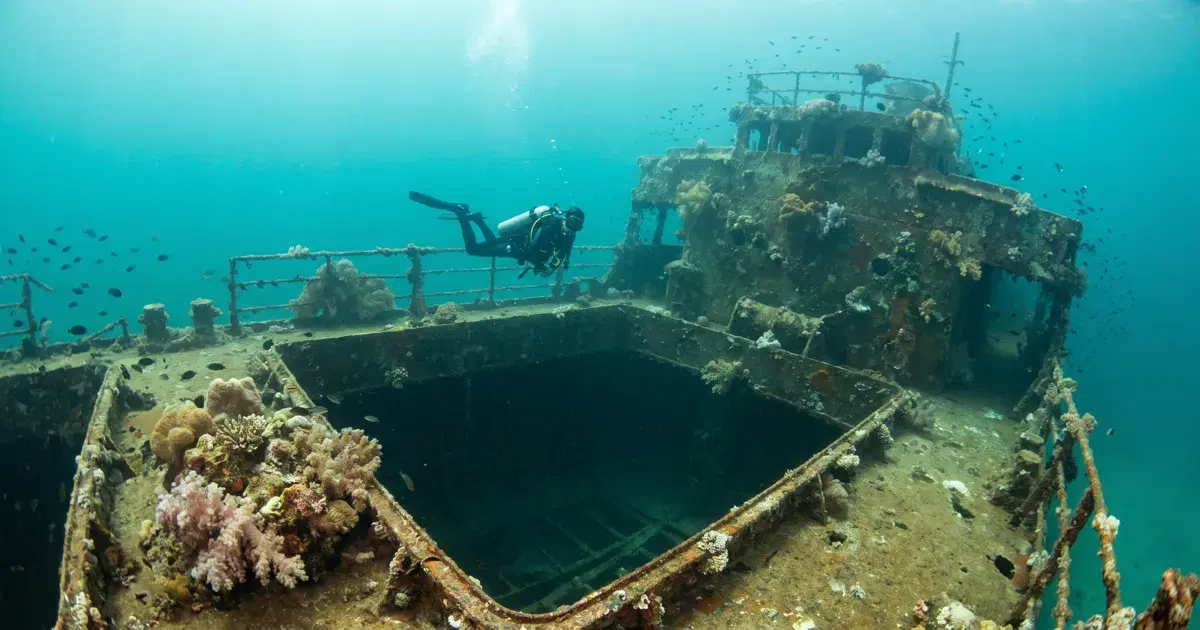
A single American airstrike in September 1944 put roughly a dozen Japanese vessels on the bottom of Coron Bay in one afternoon, and that concentration is why Coron ranks among the world's best wreck-diving destinations without needing a second attraction.
Which Coron WWII wrecks are beginner-friendly vs technical?
The Okikawa Maru and Kogyo Maru sit shallow enough, roughly 10 to 26 meters, for Open Water divers to explore the exteriors and larger openings comfortably. The Irako, a refrigeration ship resting deeper around 26 to 42 meters, and any real penetration into engine rooms or cargo holds on the deeper wrecks, calls for Advanced certification at minimum, with true wreck-penetration training required for anything beyond swim-through-style openings.
Do I need wreck-diving certification for Coron?
Not for exterior dives on the shallower wrecks, which most operators run as standard Advanced Open Water or even Open Water excursions with a guide. Actual penetration into a wreck's interior, entering enclosed spaces beyond direct-light swim-throughs, does require wreck-specialty certification, and reputable Coron operators enforce this distinction rather than letting untrained divers wander into overhead environments.
Best time to dive the Coron wrecks?
Coron is diveable year-round without a hard closed season, with roughly December through May the drier, calmer window before the June-through-November wet season brings a higher chance of rough surface conditions and reduced visibility on some days. Visibility on the wrecks themselves varies more by depth and recent weather than by month, often running clearer on the deeper wrecks like the Irako than on shallower, more current-affected sites.
How deep are the Coron wrecks?
They span a wide range: the shallowest wreck, the Lusong gunboat, sits in just 1 to 8 meters, snorkel-accessible in places, while the Irako bottoms out near 42 meters. Most of the well-known dive wrecks, the Okikawa Maru, Kogyo Maru, and Akitsushima, fall in the 10-to-34-meter range, which is what makes Coron workable across such a wide span of certification levels on the same trip.
Coron vs Subic Bay wreck diving — which is better?
Subic Bay, near Manila, offers a smaller cluster of wrecks including the USS New York and is far more convenient for a short trip from the capital. Coron has a considerably larger concentration of distinct wrecks in a single bay and a stronger reputation among dedicated wreck divers internationally, but requires the extra flight and travel time to reach. Divers with limited time near Manila often choose Subic Bay; divers building a wreck-diving trip around the destination itself choose Coron.
What is the history behind the Coron wrecks (Operation Kingpin)?
On September 24, 1944, US Navy carrier aircraft launched a surprise strike, codenamed Operation Kingpin, against a Japanese supply fleet sheltering in Coron Bay, believing it hidden from Allied reconnaissance. The strike sank roughly a dozen vessels in a single engagement, and most of what divers explore today are the remains of that one day's action, largely undisturbed in the decades since.
Is Coron wreck diving worth it if I am not a wreck diver?
Yes. Coron pairs its wrecks with genuinely good reef and island scenery, Kayangan Lake and Barracuda Lake among them, so a trip built around a couple of wreck dives, a reef stop at Siete Pecados, and the lake excursions works well even for a diver whose main interest isn't wrecks specifically. The wrecks alone are worth a dedicated stop for anyone even mildly curious, given how few destinations offer this many distinct WWII sites within one small bay. Divers wanting to pair Coron's wrecks with a completely different diving profile sometimes extend to Tubbataha Reef, a liveaboard-only UNESCO World Heritage site reached via Puerto Princesa with remote atoll walls, sharks, and pelagics rather than wrecks and lakes — though it runs on a separate, much shorter seasonal window than Coron's near-year-round diving, so the two trips need to be planned around different calendars.
FAQ
How many Coron wrecks can I realistically dive in one trip? Four to five days typically covers five or six of the main wrecks at a comfortable pace; serious wreck divers sometimes extend to a week to include the deeper, less-visited sites.
Is Coron wreck diving suitable for a first wreck-diving experience? Yes, for the shallower wrecks with a guide. The range of depths across Coron's wreck fleet means a first-timer can start shallow and build confidence before attempting anything deeper on the same trip.
Are there penalties for touching or removing artifacts from the Coron wrecks? Yes, the wrecks are protected historical and dive-tourism sites, and removing artifacts or damaging the wrecks is prohibited under local regulations enforced by dive operators and local authorities.