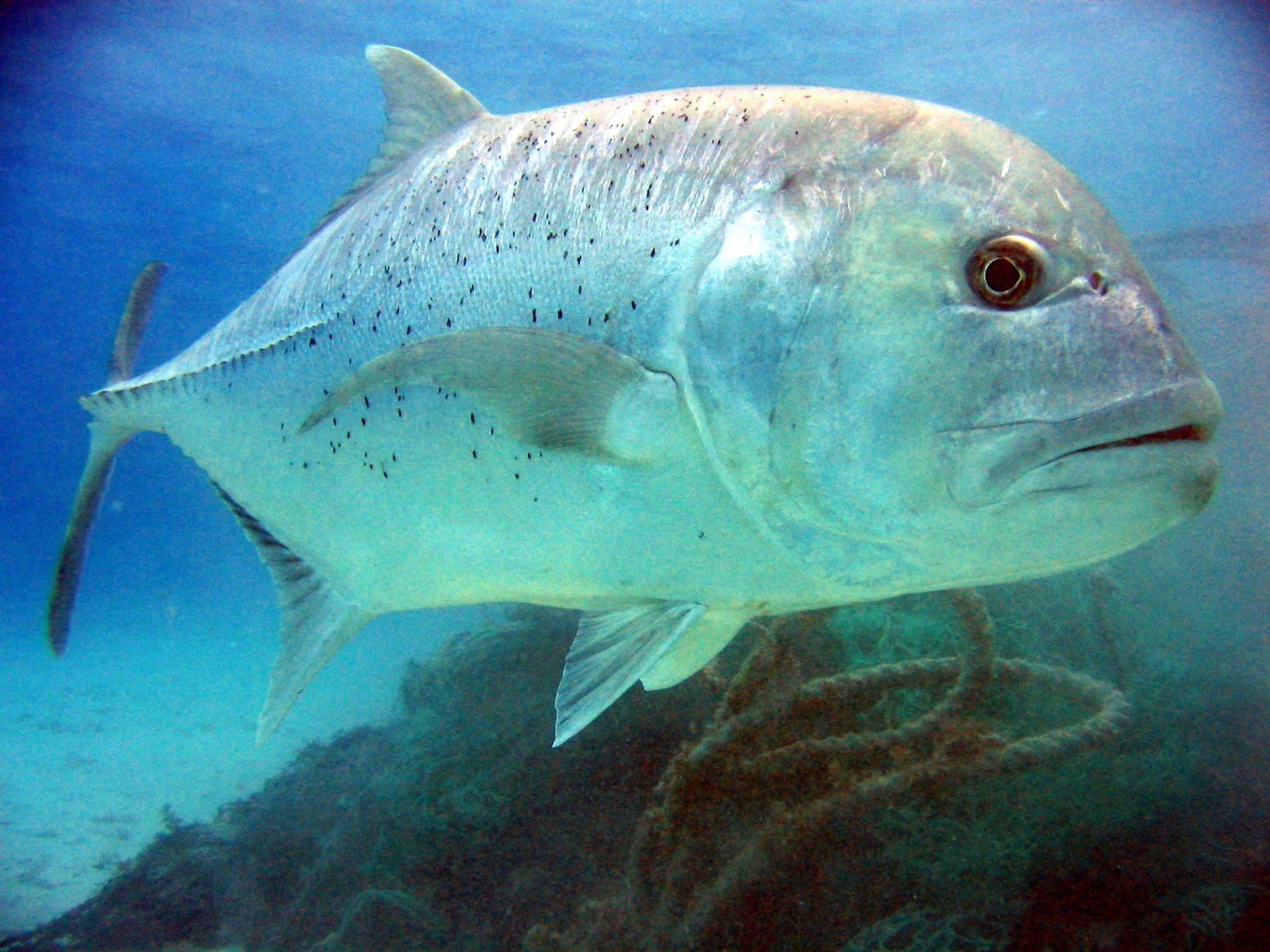
Giant Trevally
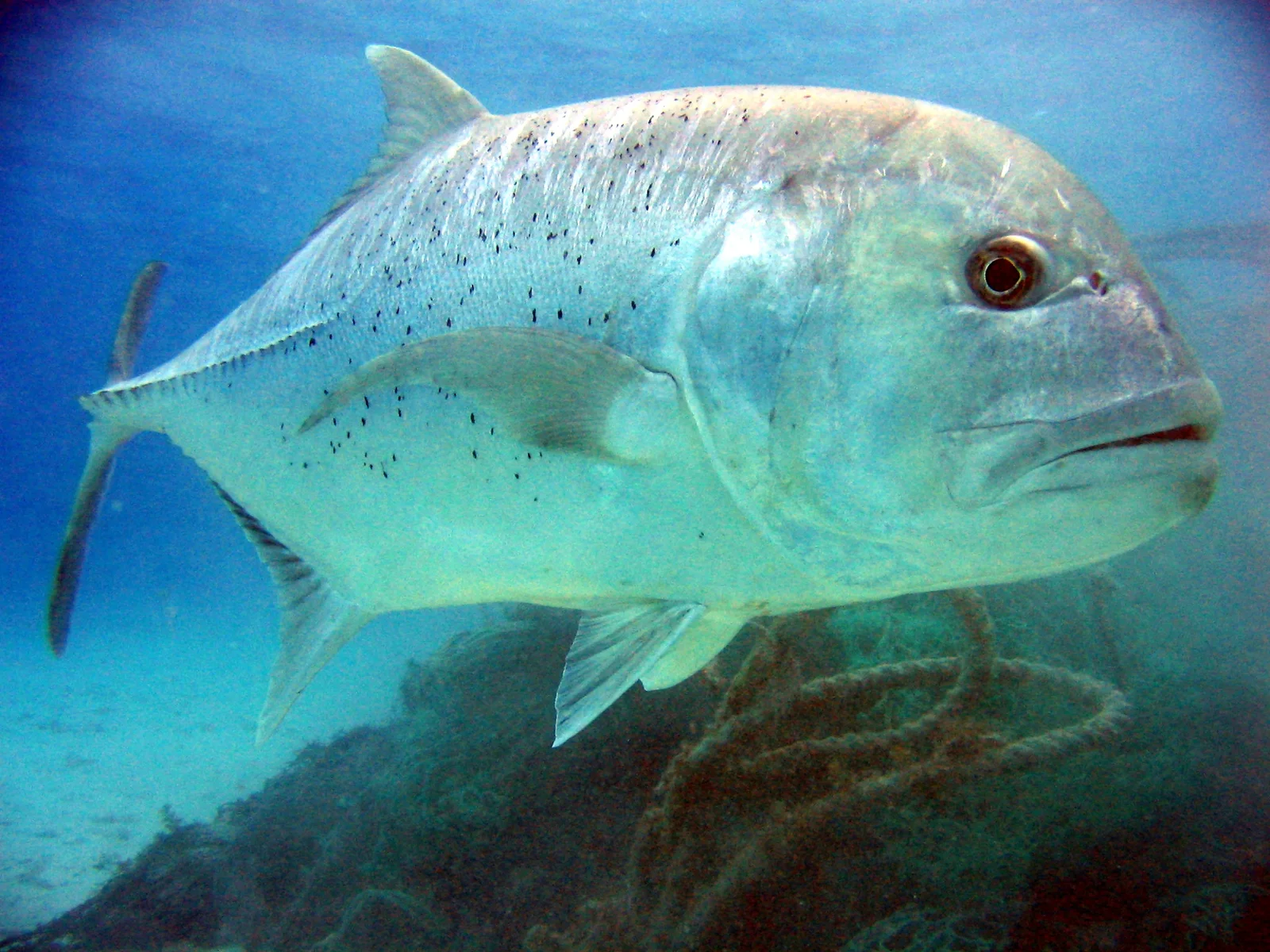
Caranx ignobilis
About Giant Trevally.
The Giant Trevally (Caranx ignobilis), often simply referred to as GT, is an apex predatory jack belonging to the family Carangidae. Renowned for its formidable presence and powerful hunting prowess, this species is a highly sought-after encounter for divers across its range. It is also known by other common names such as lowly trevally, barrier trevally, giant kingfish, and ulua. The Giant Trevally holds a conservation status of Least Concern, according to the IUCN Red List.
Distributed throughout the tropical and subtropical waters of the Indo-Pacific region, its extensive range stretches from the east coast of Africa to Hawaii, encompassing northern Australia and southern Japan. GTs inhabit a wide array of marine environments, adapting from shallow bays and lagoons as juveniles to deeper reefs, offshore atolls, and large embayments as adults. They are frequently observed in clear lagoon and seaward reefs, particularly in current-swept reef passes and channels, favoring warm tropical waters typically between 24–30°C. Juveniles are known to tolerate low-salinity waters in estuaries and rivers, often preferring turbid conditions before moving to inshore and then outer reefs.
As an opportunistic and highly intelligent predator, the Giant Trevally hunts both individually and in coordinated schools. Divers may witness their tactical hunting behaviors, which include cooperative herding of prey, shadowing larger animals like monk seals or sharks to ambush unsuspecting fish, and even leaping out of the water to catch birds. Their diet primarily consists of various fish, supplemented by crustaceans, cephalopods, and molluscs. These powerful hunters are a common sight at many popular dive sites, including Batu Bolong, Castle Rock, Crystal Rock, Shotgun (The Cauldron), Golden Passage, Tatawa Kecil, Manta Alley, Three Sisters, and Mainit Point, with occasional sightings at Sepok Wall.
Identification
- Size: The Giant Trevally lives up to its name, being the largest fish in the genus Caranx. It can reach an impressive maximum length of 1.7 m (67 inches) and weigh up to 80 kg (176 lb).
- Body Shape: This species possesses a robust, muscular, and streamlined body that is broad, deep, and laterally compressed, designed for powerful, sudden bursts of speed.
- Head Profile: A key identifying feature is its steep head profile, which becomes more pronounced and blunt with age, giving older individuals a distinctive, almost prehistoric appearance. They have large, wide-set eyes and prominent lips.
- Coloration: Adults typically display a silvery to dark grey coloration, sometimes with a dusky golden hue, and may have occasional dark spots scattered across their bodies. Mature males, especially when dominant or actively hunting, can darken significantly, appearing almost black. Fish found in turbid coastal waters may exhibit yellow fins, with the anal fin often being the brightest.
- Fins: The Giant Trevally has two dorsal fins, with the second dorsal fin typically grey and featuring a black outer edge. The anal fin is usually grey to black, though it can be bright yellow. Its powerful, scythe-shaped caudal (tail) fin is deeply forked, with the upper lobe having a black outer edge and the lower lobe a pale yellow outer edge. The base of the tail is slender and reinforced by strong, bony scutes along the lateral line. The pelvic fins are often trimmed with white.
- Distinguishing Marks: A crucial identification mark is a distinct black spot located at the base of the pectoral fins on their sides, which helps differentiate them from other trevally species. They also have strong tail scutes along the straight part of the lateral line and typically lack a dark spot on the rear part of the gill cover.
Observing these distinct physical characteristics and behaviors will greatly assist divers in identifying the impressive Giant Trevally during their underwater explorations.
Where it lives.
The Giant Trevally (Caranx ignobilis) is a formidable apex predator found throughout the tropical and subtropical waters of the Indo-Pacific region. Its extensive range stretches from the Red Sea and the east coast of Africa, across to the Hawaiian and Marquesas Islands, north to southern Japan, and south to northern Australia.
This highly adaptable species inhabits a wide array of marine environments, with distinct preferences changing throughout its life stages:
- Juvenile Habitat: Young Giant Trevally are often found in inshore environments, including estuaries, shallow bays, lagoons, tidal flats, and the upper reaches of rivers. They frequently seek out turbid waters in these areas, which offer protection. As they grow, juveniles transition to patch reefs within or near lagoons before venturing into more open waters.
- Adult Habitat: Mature Giant Trevally are typically associated with clear lagoon and seaward reefs, offshore atolls, deeper reefs, bomboras, and dramatic drop-offs. They are commonly encountered by divers around reef passes, pinnacles, and current-swept walls, where they exploit strong currents to their advantage. While generally semi-pelagic, they spend a significant amount of time as demersal fish, patrolling over sand and rock substrates. They are also known to frequent large embayments and are attracted to artificial reef structures.
The Giant Trevally is typically found at depths ranging from 10 to 188 m, though it can be observed in very shallow coastal waters and estuaries (0 m). Older, larger individuals often move to depths greater than 80 m, but will return to shallower waters for hunting and reproduction. This species thrives in warm tropical waters, generally preferring temperatures between 21–30°C.
As a crucial apex predator, the Giant Trevally plays an important ecological role in reef and island ecosystems, influencing the structure and function of these habitats.
How it behaves.
The Giant Trevally, Caranx ignobilis, is a formidable and highly sought-after species among the global diving community, known for its impressive size and powerful presence on the reef. As an apex predator, its behavior is a captivating display of marine efficiency and strength.
- Underwater Encounter Behavior
Divers frequently encounter Giant Trevally patrolling coral and rocky reefs, along drop-offs, and within channels, often in areas with strong currents where baitfish congregate. These powerful fish are strong, agile swimmers, exhibiting sudden bursts of speed when hunting. While generally confident in their environment, they can be skittish and challenging to approach closely, especially when solitary. However, during active hunting or when in schools, they may be more approachable. Giant Trevally are typically found in tropical waters, thriving in temperatures ranging from 21-31°C, and are commonly observed at depths from 10 to 188 meters, though they are often seen in shallower coastal waters. Despite their predatory nature, Giant Trevally do not pose a threat to divers or snorkelers. - Feeding Habits
As opportunistic apex predators, Giant Trevally primarily feed on smaller fish, but their diet also includes crustaceans, cephalopods (like squid and octopus), and occasionally eels. Larger individuals have even been reported to consume juvenile turtles and birds, demonstrating their diverse and adaptable hunting strategies. They employ various hunting techniques, including solitary ambush, coordinated schooling to herd prey, and even shadowing other large marine animals like sharks or monk seals to ambush escaping prey. Hunting activity often peaks during the early morning or late afternoon, though some populations exhibit nocturnal habits depending on their location. - Social Structure
Adult Giant Trevally are typically observed as solitary individuals or in small groups, cruising their home ranges along reef structures. Juveniles, however, tend to form schools and inhabit shallower, more protected inshore environments such as estuaries, bays, and lagoons, moving to outer reefs as they mature. While adults generally maintain localized home ranges, they are known to make periodic journeys within these areas. - Notable Seasonal Patterns
Giant Trevally exhibit distinct seasonal patterns primarily related to reproduction. Spawning generally occurs during the warmer months, with specific peaks varying by region and often coinciding with lunar cycles. During these periods, large aggregations of Giant Trevally form over offshore banks and shallow seaward reefs for spawning. In Hawaii, spawning typically peaks in June, while in other areas, it can occur from May to August or even extend from April to November. These spawning migrations can involve significant movements, with some individuals traveling up to 30 km or more to reach traditional spawning grounds. This site fidelity to spawning areas is a crucial aspect of their life cycle.
Where to see it.
Evidence for philippines · 8 dive sites
General range is not evidence of occurrence at a specific dive site.
Alma Jane Wreck
Puerto Galera
Site occurrence not yet documented
Season not yet documented
No dated observations available.
Ligpo Island
Anilao
Site occurrence not yet documented
Season not yet documented
No dated observations available.
Mainit Point
Anilao
Site occurrence not yet documented
Season not yet documented
No dated observations available.
North Rock
El Nido
Site occurrence not yet documented
Season not yet documented
No dated observations available.
Sepok Wall
Anilao
Site occurrence not yet documented
Season not yet documented
No dated observations available.
Twin Rocks
El Nido
Site occurrence not yet documented
Season not yet documented
No dated observations available.
Washing Machine (Verde Island)
Verde Island
Site occurrence not yet documented
Season not yet documented
No dated observations available.
West Escarceo
Puerto Galera
Site occurrence not yet documented
Season not yet documented
No dated observations available.
Gallery.