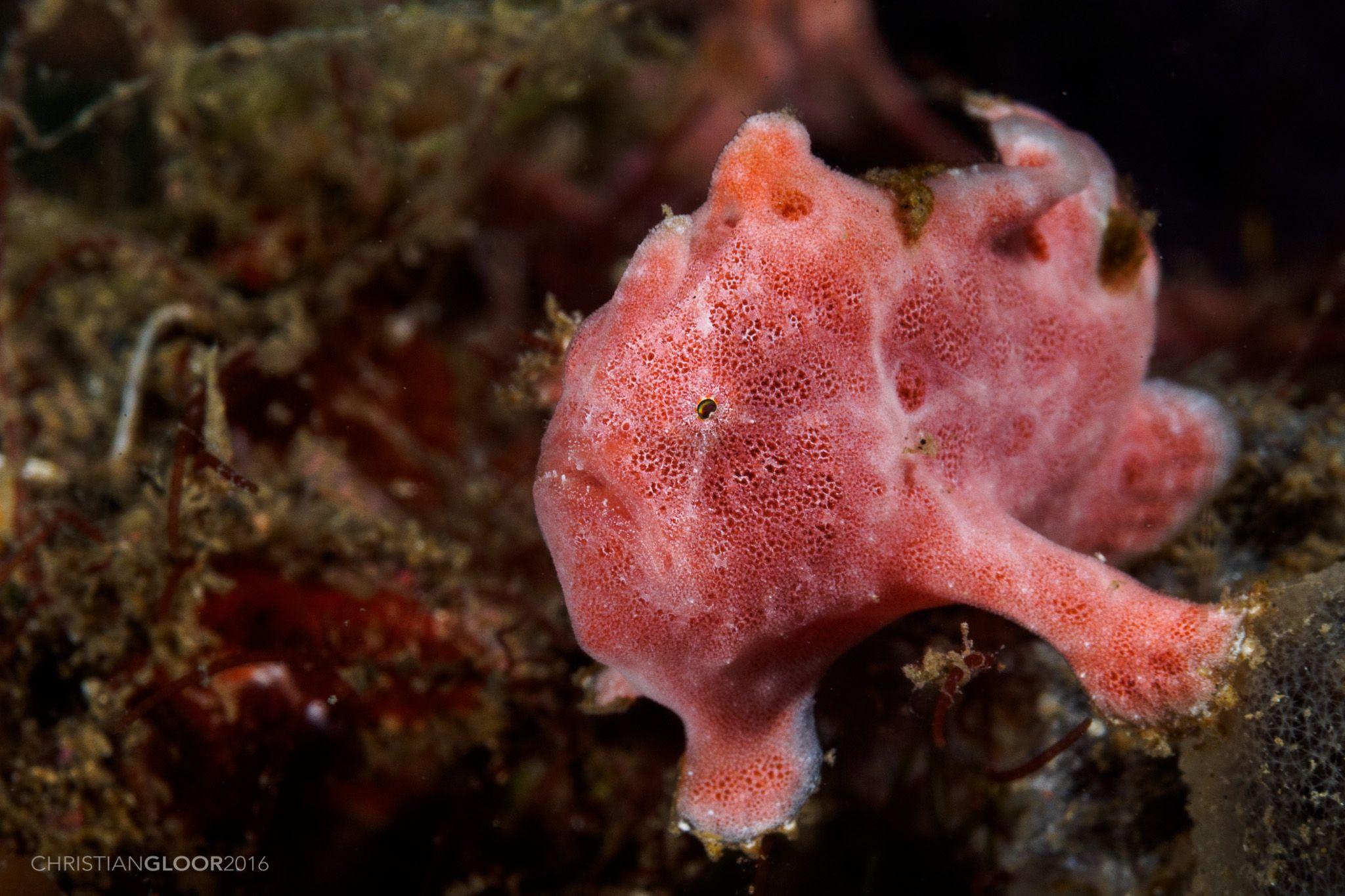
Painted Frogfish
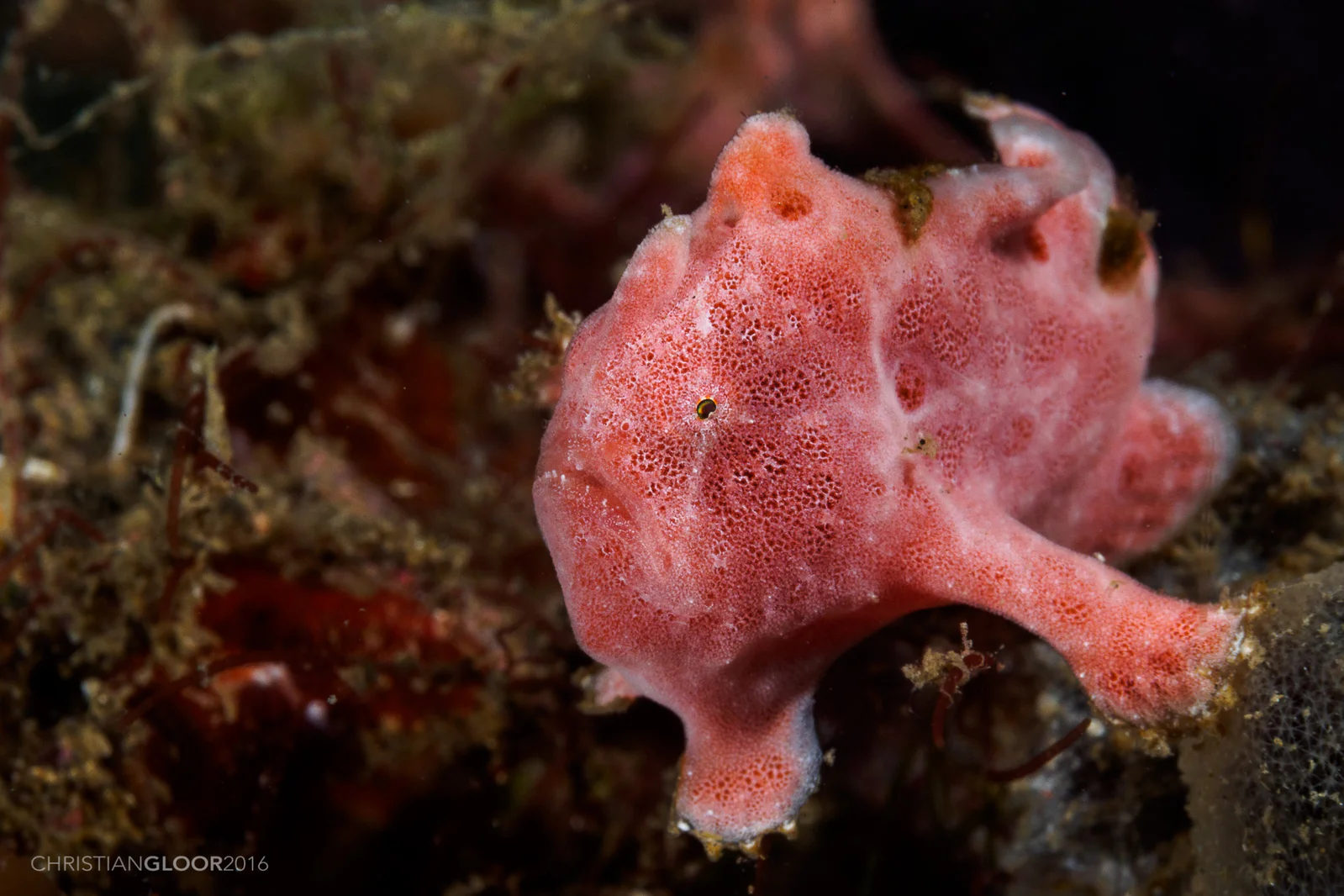
Antennarius pictus
About Painted Frogfish.
The Painted Frogfish, scientifically known as Antennarius pictus, is a captivating macro species belonging to the family Antennariidae, commonly referred to as frogfishes or anglerfishes. This master of camouflage is a favorite among divers for its incredible ability to blend seamlessly into its surroundings. Its conservation status is currently listed as Least Concern, reflecting its widespread distribution.
Found throughout the tropical and subtropical waters of the Indo-Pacific, its range extends from the Red Sea and East Africa eastward to Hawaii and French Polynesia, and from southern Japan southward to Australia. These benthic creatures inhabit sheltered rocky and coral reefs, often associating with sponges, rubble, sandy bottoms, and even algal beds. They are typically observed at depths of 0–75 m, with an average occurrence around 15 m, in waters ranging from 25–29°C. The Painted Frogfish leads a solitary, ambush-predator lifestyle, sitting motionless and utilizing its specialized lure to attract unsuspecting prey. Its diet primarily consists of small fish and crustaceans, which it captures with one of the fastest strike speeds in the animal kingdom.
This species is a common sight at many popular dive sites, including St. Christopher Wreck, Basura, Daryl Laut (Wreck), and Kirby's Rock. It is also occasionally observed at Sepok Wall, Arco Point, Talisay Pier, Arborek Jetty, Cross Wreck, and Kalipayan.
Identification
- Size: The Painted Frogfish can grow up to a maximum size of 30 cm (12 in).
- Body and Skin: It possesses a globulous, extensible body covered in soft skin with small dermal spinules. The skin is further adorned with small, wart-like protuberances, variably shaped, scab-like blotches, and numerous small eye spots (ocelli) that mimic sponge holes, enhancing its camouflage.
- Coloration and Pattern: Its most striking feature is its highly variable coloration, which can change within weeks to perfectly match its immediate environment. Colors range from white, cream, pink, yellow, orange, red, brown, to black. Patterns typically include circular eye spots darker than the background, irregular spots, and saddle-like or 'scabby-looking' patches.
- Illicium and Esca: A defining characteristic is its modified first dorsal spine, known as the illicium or "fishing rod," which is often darkly banded and nearly twice the length of its second dorsal spine. At the tip of the illicium is the esca, a filamentous lure resembling a small fish or shrimp, typically pinkish to brownish, used to entice prey.
- Dorsal Spines: The second dorsal spine is straight and mobile, while the third is bent backward. Both are membranously attached to the head and distinctly separated from each other and the main dorsal fin.
- Fins: Its angled pectoral fins, sometimes with white tips, assist in moving along the substrate and maintaining a stable ambush position. The caudal fin may also feature three distinct eye spots.
- Mouth: A large, prognathous mouth allows it to consume prey nearly its own size.
- Juveniles: Younger individuals often display a dark background color with small yellow spots, or a striking black body with orange spots and blue tips on all fins and the tail.
Where it lives.
The Antennarius pictus, commonly known as the Painted Frogfish, is a master of camouflage, perfectly adapted to its diverse marine environments across the vast Indo-Pacific region. This species exhibits a wide geographic distribution, inhabiting tropical and subtropical waters from the Red Sea and East African coast, through the Persian Gulf, Bay of Bengal, and Indonesian seas, extending to the Philippine Sea, Great Barrier Reef, East China Sea, and Sea of Japan. Its range reaches as far east as Hawaii and the Society Islands (French Polynesia), north to Jeju Island in Korea and the Ryukyu Islands, and south to Western Australia and Lord Howe Island.
Divers can typically encounter the Painted Frogfish at depths ranging from the shallows down to 75 m, though it is most frequently observed around 15 m. It thrives in warm waters, naturally found in temperatures between 24–29°C.
This solitary, benthic species prefers a variety of habitats, often blending seamlessly with its surroundings. Key ecosystems and substrates include:
- Reef Environments: Sheltered rocky and coral reefs are primary habitats, where adults are commonly associated with sponges, utilizing them for camouflage.
- Rubble and Muck: Dive sites characterized by rubble and sandy bottoms with scattered debris are also favored, providing ample hiding spots for this ambush predator.
- Other Substrates: They can also be found among algal beds, or perched on mooring lines and other submerged structures. Juveniles may be observed openly on sand or reef, mimicking small sponges or even nudibranchs to avoid detection.
- Coastal Areas: The Painted Frogfish also inhabits lagoons, estuaries, and bays.
Its remarkable ability to change coloration and pigment patterns over several weeks allows it to perfectly match its immediate environment, appearing in shades of white, cream, yellow, orange, pink, red, brown, or black, often adorned with spots, blotches, or scab-like patches.
How it behaves.
The Painted Frogfish (Antennarius pictus) is a master of disguise, making it a captivating, albeit challenging, subject for divers. Known for its sedentary, lure-and-strike ambush hunting strategy, this species is a highlight for macro enthusiasts on many Indo-Pacific dive sites.
Underwater Encounter Behavior
- Camouflage Experts: Painted Frogfish are renowned for their exceptional camouflage, allowing them to blend seamlessly with their surroundings, often resembling sponges, coral, or rubble. Their skin is covered with wart-like protuberances and small eye spots, further enhancing their mimicry. They possess the remarkable ability to change their coloration and pigment patterns over a few weeks to match their immediate environment, ranging from white, yellow, red, pink, brown, to black.
- Movement: Unlike most fish, Painted Frogfish rarely swim. Instead, they use their modified pectoral and pelvic fins to "walk" or crawl across the reef in slow, deliberate steps. This unique gait helps them move without alerting prey or predators. Divers often need a keen eye and patience to spot these creatures, as they can remain motionless in the same area for days or even weeks.
- Diver Interaction: Generally, Painted Frogfish are not concerned by the presence of divers, especially outside of hunting. Their primary defense is their camouflage, and they typically remain still when approached. Careful, slow movements and stable buoyancy are recommended to observe them without disturbing their natural behavior or stirring up silt.
Feeding Habits
- Ambush Predators: The Painted Frogfish is a voracious carnivore and a highly specialized ambush predator. It employs a unique "lure-and-strike" technique.
- The Lure (Illicium and Esca): A modified first dorsal-fin spine, called an illicium, protrudes from its head, tipped with a fleshy appendage known as an esca. This esca mimics small prey animals like worms, shrimp, or tiny fish. The frogfish wiggles this lure to attract unsuspecting prey within striking distance. If the lure is bitten off, it can regenerate within a few months.
- Diet and Strike: Their diet primarily consists of small fish and crustaceans. With one of the fastest suction-feeding attacks among vertebrates, the frogfish can expand its large, prognathous mouth up to 12 times its normal size and engulf prey in about 6 milliseconds, creating a vortex that sucks the meal in whole. They are opportunistic and can even attack prey close to their own size, including other frogfish.
Social Structure
- Solitary Lifestyle: Painted Frogfish are predominantly solitary creatures, leading a benthic lifestyle. They are generally not social and prefer to remain alone on the seafloor.
- Reproduction: Social interaction is minimal, primarily occurring during mating periods. During this time, males and females gather to spawn, but they become intolerant of each other shortly after fertilization. In some instances, the male may even consume the female if she remains too close post-mating. Reproduction involves broadcast spawning, where females release buoyant, jelly-like egg masses (sometimes called rafts) that are then externally fertilized by the male. There is no parental care, and the larvae are pelagic for the first few months of their lives.
Notable Seasonal Patterns
- Year-Round Presence: Painted Frogfish are generally observed year-round in their tropical and subtropical Indo-Pacific habitats, which range from the Red Sea and East Africa to Hawaii and the Society Islands. They are found in waters typically between 25°C and 29°C.
- Breeding: While specific peak breeding seasons for Antennarius pictus are not extensively documented for divers, mating is a transient event where individuals briefly come together. Females can produce a large number of eggs, ranging from 40,000 to 180,000 per season. The larvae hatch after 2-5 days and spend a few months in a pelagic stage before settling onto the reef. Divers may occasionally observe a female swollen with eggs just before spawning.
Where to see it.
Evidence for philippines · 8 dive sites
General range is not evidence of occurrence at a specific dive site.
Arco Point
Panglao
Site occurrence not yet documented
Season not yet documented
No dated observations available.
Basura
Anilao
Site occurrence not yet documented
Season not yet documented
No dated observations available.
Daryl Laut (Wreck)
Anilao
Site occurrence not yet documented
Season not yet documented
No dated observations available.
Kalipayan
Panglao
Site occurrence not yet documented
Season not yet documented
No dated observations available.
Kirby's Rock
Anilao
Site occurrence not yet documented
Season not yet documented
No dated observations available.
Sepok Wall
Anilao
Site occurrence not yet documented
Season not yet documented
No dated observations available.
St. Christopher Wreck
Puerto Galera
Site occurrence not yet documented
Season not yet documented
No dated observations available.
Talisay Pier
Cabilao Island
Site occurrence not yet documented
Documented site seasonality: Jan, Feb, Mar, Apr, May, Jun, Jul, Aug, Sep, Oct, Nov, Dec
No dated observations available.
Gallery.