Giant Moray
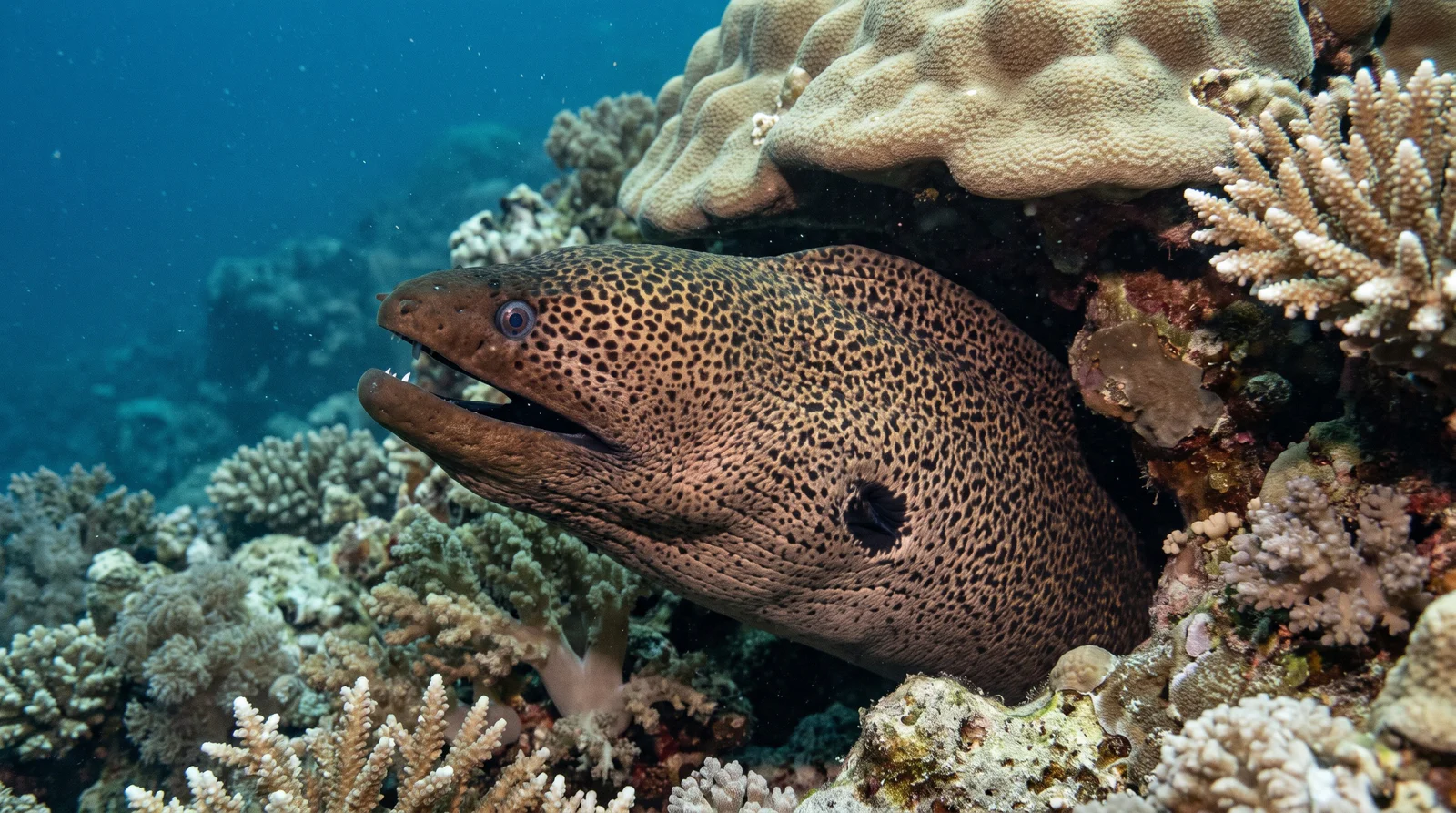 AI-generated
Image credit: AI-generated illustration · License unspecified · Source unspecified
Gymnothorax javanicus
About Giant Moray.
The Giant Moray (Gymnothorax javanicus) is a formidable and captivating inhabitant of Indo-Pacific coral reefs, renowned as the largest moray eel species by mass in the region. Belonging to the family Muraenidae, this impressive fish plays a crucial role as an apex predator in its ecosystem. Its conservation status is currently listed as Least Concern.
Found across a vast expanse of tropical waters, from the Red Sea and East Africa to the Hawaiian Islands and Polynesia, and extending north to Japan and south to Australia, the Giant Moray thrives in diverse reef habitats. Divers commonly encounter them at depths of 1–50 m, though they are most frequently observed between 5–30 m, in waters typically ranging from 24–30°C. They prefer to shelter in crevices, caves, and under ledges during the day, emerging as nocturnal, carnivorous ambush predators to hunt fish, crustaceans, and even octopuses.
One of the most fascinating aspects of the Giant Moray's behavior is its documented cooperative hunting with other reef predators, particularly groupers like the Roving Coral Grouper (Plectropomus pessuliferus). In these remarkable partnerships, the grouper may signal to the moray to flush prey from reef crevices, while the moray's presence can drive prey into the open water for the grouper, demonstrating a mutually beneficial strategy. Despite their fearsome appearance and powerful jaws, Giant Morays are generally not aggressive towards humans unless provoked.
This species is a common sight at many popular dive sites, including:
- Blue Hole (Dahab)
- Banana Reef
- North Horn
- St. Christopher Wreck
- Kogyo Maru
- Napaling Reef
- Batu Bolong
- Ras Mohammed National Park
- Kirby's Rock
- Cathedral
Identification
The Giant Moray is easily identifiable by several key physical characteristics:
- Size: As its name suggests, it is a truly massive eel, capable of reaching an impressive length of up to 3 m and weighing over 30 kg, making it the largest moray by mass in the Indo-Pacific.
- Body: It possesses a thick, muscular, and sinuous eel-like body that tapers towards a narrow tail. Its skin is scaleless and covered in a protective layer of mucus, aiding its movement through tight coral crevices.
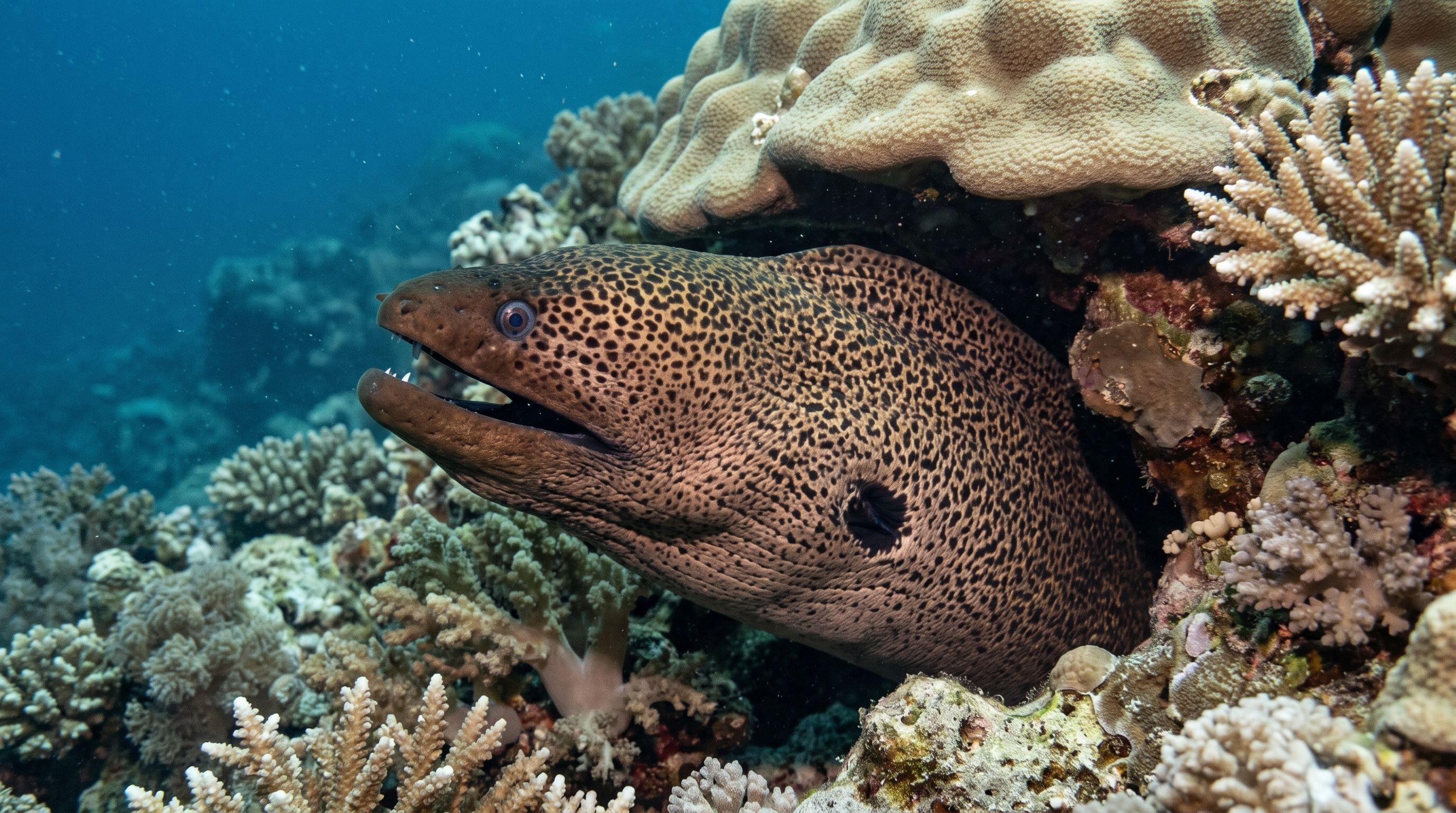
- Coloration: Adults typically exhibit a deep-brown base color adorned with irregular dark black spots, creating a mottled, leopard-like pattern that becomes more pronounced behind the head. Juveniles are generally tan with more distinct large black spots.
- Head: The head is broad and robust, often appearing yellow to brown. It features large, unblinking eyes and prominent tubular nostrils.
- Mouth and Teeth: The Giant Moray is frequently observed with its mouth agape, a behavior primarily for respiration (pumping water over its gills) rather than aggression. Its mouth is lined with multiple rows of sharp, inward-pointing teeth, including two longer, hook-like teeth in the middle of the palate. A unique feature of morays is their secondary set of pharyngeal jaws, located in the throat, which extend forward to grasp and pull prey into the digestive tract.
- Gill Opening: A distinctive black blotch surrounds the gill opening, located just behind the head.
- Fins: Like other morays, it lacks pectoral and pelvic fins, contributing to its snake-like profile. A continuous dorsal fin runs along the entire length of its body.
Where it lives.
- Coral Reef Systems: Giant Morays are strongly associated with vibrant coral reefs, including shallow lagoons, outer reef slopes, and steep drop-offs.
- Rocky Formations: They frequently seek refuge within rocky outcrops, boulder formations, and extensive cave networks.
- Crevices and Ledges: During the day, these eels are typically found concealed in crevices, holes between corals, and under ledges, emerging primarily at night to hunt.
- Substrate Preference: They favor substrates that provide structural complexity for hiding, such as rocky or coral rubble bottoms, generally avoiding open sandy areas lacking such refuges.
How it behaves.
Underwater Encounter Behavior
Giant Morays are primarily crevice-bound during the day, often observed with their heads protruding from rocky outcrops, coral formations, or reef holes, typically encountered at depths of 1 to 50 m. Their perpetually open mouths, which might appear aggressive, are actually essential for respiration, as they continuously pump water across their gills. While generally shy and non-aggressive, Giant Morays possess powerful jaws and sharp teeth, capable of inflicting serious injury if provoked or threatened. Divers should maintain a respectful distance and avoid placing hands into crevices where these eels might be hiding, as they can mistake fingers for prey due to their notoriously poor eyesight, relying more on their acute sense of smell. Despite their intimidating appearance, some individuals have been noted to be quite bold, approaching divers out of curiosity.Feeding Habits
As carnivorous ambush predators, Giant Morays are predominantly nocturnal hunters. They emerge from their daytime refuges during twilight hours to patrol their territories, utilizing their excellent sense of smell to locate prey hidden within crevices and coral formations. Their diet primarily consists of reef fish and occasionally crustaceans such as crabs and shrimp, and they have also been identified as natural predators of invasive lionfish in some areas. A remarkable adaptation for hunting is their unique pharyngeal jaw system—a second set of jaws located in their throat that can be projected forward with lightning speed to grasp prey and pull it deep into their gullet. Giant Morays are also known to engage in sophisticated cooperative hunting with other reef predators, such as roving coral groupers. In these instances, groupers may signal to the moray to initiate a joint search, with the eel flushing prey from reef crevices while the grouper catches those attempting to escape into open water, or vice versa.Social Structure
Giant Morays are largely solitary and territorial animals, typically found alone in their reef shelters. They will aggressively defend their lair against rival morays. However, they readily engage in mutualistic relationships with cleaner wrasses and cleaner shrimp. These smaller organisms are frequently observed cleaning the moray's skin, gills, and even inside its mouth, removing parasites and dead tissue, which benefits both parties. This cleaning behavior can occur both during the day and at night, with different species of cleaners active at various times.Notable Seasonal Patterns
Giant Morays reach sexual maturity relatively late, typically at 4-6 years of age. They are protogynous hermaphrodites, meaning they begin life as females and can change to males later, usually when they reach lengths of 1.5-2 meters. Spawning generally occurs during warmer months, often from April through September in much of their range, coinciding with peak water temperatures and optimal food availability. During courtship, which can happen at any time of year when water temperatures are high, morays may engage in elaborate swimming displays, intertwining their bodies in a "beautiful dance" that can last for hours. Females release hundreds of thousands of pelagic eggs into the water column, which are then fertilized by males. The larvae undergo an extended planktonic stage, drifting with oceanic currents for 6-12 months before settling on the reef and developing into young eels. While there are reports of morays undertaking long journeys for breeding, specific seasonal migrations relevant to divers are not consistently documented across their entire range. Understanding the behavior of the Giant Moray enhances the diving experience, allowing for appreciation of these fascinating apex predators in their natural reef environment.Where to see it.
Evidence for philippines · 17 dive sites
General range is not evidence of occurrence at a specific dive site.
Arco Point
Panglao
Site occurrence not yet documented
Season not yet documented
No dated observations available.
Balicasag Sanctuary (Rico's Wall)
Panglao
Site occurrence not yet documented
Season not yet documented
No dated observations available.
Cathedral
Anilao
Site occurrence not yet documented
Season not yet documented
No dated observations available.
Cathedral
Panglao
Site occurrence not yet documented
Season not yet documented
No dated observations available.
Cervera Shoal
Panglao
Site occurrence not yet documented
Season not yet documented
No dated observations available.
Japanese Wreck
Puerto Galera
Site occurrence not yet documented
Season not yet documented
No dated observations available.
Kirby's Rock
Anilao
Site occurrence not yet documented
Season not yet documented
No dated observations available.
Kogyo Maru
Coron
Site occurrence not yet documented
Season not yet documented
No dated observations available.
La Laguna Point
Puerto Galera
Site occurrence not yet documented
Season not yet documented
No dated observations available.
Ligpo Island
Anilao
Site occurrence not yet documented
Season not yet documented
No dated observations available.
Napaling Reef
Panglao
Site occurrence not yet documented
Season not yet documented
No dated observations available.
Odie's Wall
Puerto Galera
Site occurrence not yet documented
Season not yet documented
No dated observations available.
Rudy's Rock
Panglao
Site occurrence not yet documented
Season not yet documented
No dated observations available.
St. Christopher Wreck
Puerto Galera
Site occurrence not yet documented
Season not yet documented
No dated observations available.
The Atoll
Puerto Galera
Site occurrence not yet documented
Season not yet documented
No dated observations available.
Twin Rocks
El Nido
Site occurrence not yet documented
Season not yet documented
No dated observations available.
Wreck Point
Puerto Galera
Site occurrence not yet documented
Season not yet documented
No dated observations available.
Gallery.
 AI-generated
AI-generated illustration
Image credit: AI-generated illustration · License unspecified · Source unspecified