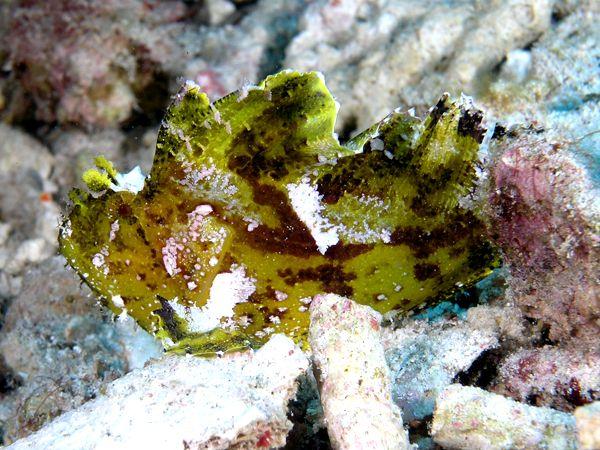
Leaf Scorpionfish
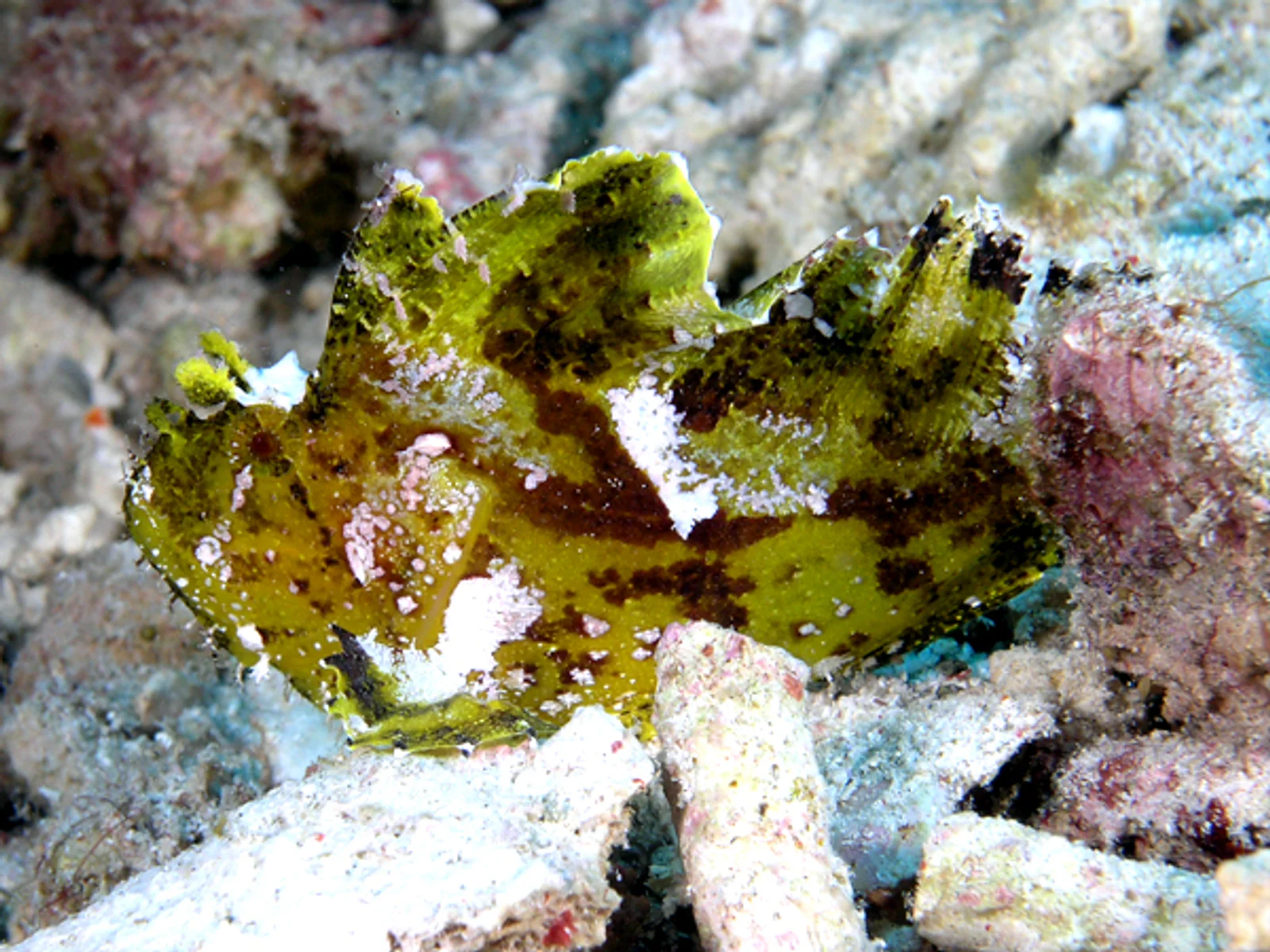
Taenianotus triacanthus
About Leaf Scorpionfish.
The Leaf Scorpionfish (Taenianotus triacanthus) is a master of disguise, a fascinating and often elusive inhabitant of Indo-Pacific coral reefs. This small, paper-thin ambush predator is renowned for its incredible camouflage, seamlessly blending into its surroundings by mimicking a decaying leaf or algae. Divers often need a keen eye to spot this unique fish, which remains largely motionless, swaying gently with the water's surge, making it a rewarding discovery on any dive site.
Belonging to the family Scorpaenidae, the Leaf Scorpionfish is the sole species in its genus, Taenianotus. It is a carnivorous predator, feeding primarily on small crustaceans, larvae, and tiny fish that venture too close to its camouflaged perch. Despite its delicate appearance, it possesses venomous spines, a characteristic shared with many of its scorpionfish relatives, though its venom is considered weaker than that of lionfish or stonefish. The species is widely distributed across the tropical Indo-Pacific, from East Africa to the Galapagos Islands, and north to Japan and south to Australia. It is typically found at depths of 5–20 m, though observations range from 1–134 m, in waters of 22–26°C. Its conservation status is currently listed as Least Concern.
Identification
- Size and Body Shape: The Leaf Scorpionfish is a small species, reaching a maximum size of 10 cm (4 in). Its most distinctive feature is its extremely compressed, paper-thin body, which gives it a flattened, leaf-like profile.
- Coloration: This species exhibits highly variable coloration, ranging from white, yellow, pink, red, brown, green, black, purple, or ocher, often with blotchy or mottled patterns that enhance its cryptic camouflage. Interestingly, the Leaf Scorpionfish periodically sheds its skin, typically every 10–14 days, and can change its color after molting to better match its environment.
- Fins: A prominent, sail-like dorsal fin runs almost the entire length of its back, starting just behind the eyes and featuring 12 spines and 8–11 soft rays. The caudal fin is relatively large and often points upwards. It also possesses three spines and 5–6 soft rays in its anal fin.
- Head and Mouth: The head and mouth are relatively large for its body size. Some individuals may display a variably developed 'beard' of fine appendages around the mouth, further aiding in camouflage.
- Skin Texture: Instead of typical scales, its skin is covered in prickly papillae.
- Behavior: When observed, the Leaf Scorpionfish is usually solitary or found in pairs, often perched motionless on hard corals, sponges, hydroids, gorgonians, or rubble. It enhances its mimicry by swaying gently from side to side with the water current, appearing like a piece of drifting debris. This "unique sitting action" involves bending its head lower than its tail.
Where it lives.
The Taenianotus triacanthus, commonly known as the Leaf Scorpionfish, is a master of camouflage, perfectly adapted to its diverse habitats across the vast Indo-Pacific region. This fascinating species is widely distributed, ranging from the East African coast and the Red Sea, across to the Galapagos Islands, extending north to the Ryukyu Islands of southern Japan and Hawaii, and southwards to Australia (specifically northern New South Wales) and the Tuamoto Islands in French Polynesia.
Divers can encounter the Leaf Scorpionfish in a variety of reef-associated environments, typically found at depths ranging from shallow waters of 1–2 m down to an impressive 130–134 m. While they can be found quite deep, they are most frequently observed by recreational divers between 5–20 m. These benthic fish prefer tropical waters, thriving in temperatures between 22–26°C.
Their preferred ecosystems include vibrant coral reefs, reef flats, outer reef slopes, and current-swept channels, though they are occasionally spotted on lagoon reefs. The Leaf Scorpionfish is typically solitary, though pairs or small groups can sometimes be seen. They are ambush predators, often remaining motionless as they sway gently from side to side, expertly mimicking a dead leaf or drifting debris to avoid detection and surprise unsuspecting prey.
When searching for this elusive creature on a dive site, look for them perched in areas that offer both camouflage and a vantage point for hunting. Their favored substrates and hiding spots include:
- Reef rubble and ledges: Providing ideal nooks and crannies for concealment.
- Sponge patches: Blending seamlessly with the texture and form of sponges.
- Algae and seagrass beds: Where their leaf-like appearance is most effective.
- Coral branches and cracks: Offering structural cover within the reef.
- Sandy bottoms: Often found leaning against rocks, especially in areas with moderate water flow that enhances their swaying camouflage.
Adding to their remarkable camouflage, Leaf Scorpionfish periodically shed their skin (molting every 10–14 days) and can change their coloration to match their surroundings, appearing in shades of white, yellow, green, pink, red, brown, or even black.
How it behaves.
The Leaf Scorpionfish (Taenianotus triacanthus), also known as Paperfish or Sailfin Leaffish, is a master of camouflage, making it a captivating yet challenging subject for divers to spot. Reaching a maximum size of 10 cm (4 in), this small member of the Scorpaenidae family is renowned for its remarkable ability to blend seamlessly into its reef environment.
Underwater Encounter Behavior
- Camouflage and Mimicry: The Leaf Scorpionfish's most striking behavior is its incredible camouflage. Its laterally compressed body, tall dorsal fin, and varied coloration (ranging from white, yellow, pink, red, brown, green, to black) allow it to perfectly mimic a decaying leaf or drifting debris. To enhance this illusion, it gently sways back and forth with the water current, a behavior that often causes even experienced divers to swim past without noticing it.
- Sedentary Nature: These fish are largely sedentary ambush predators, preferring to perch motionless on corals, sponges, sea fans, or rocky outcrops rather than actively swimming. When they do move, they tend to "hop" or "walk" on their pectoral fins. They often remain loyal to a small home territory, meaning a specimen might be found in the same spot on consecutive dives.
- Venomous Spines: Like other scorpionfish, Taenianotus triacanthus possesses venomous spines in its dorsal, pelvic, and anal fins. While its venom is generally considered milder than that of lionfish or stonefish, a sting can still be painful. Divers should maintain a respectful distance and avoid touching the reef to prevent accidental contact.
Feeding Habits
- Ambush Predator: The Leaf Scorpionfish is a carnivorous ambush predator. It relies entirely on its camouflage to remain undetected by unsuspecting prey.
- Diet: Its diet primarily consists of small fish, shrimp, larvae, and other crustaceans that venture too close.
- Hunting Technique: When prey is within striking range, the Leaf Scorpionfish strikes with astonishing speed, rapidly opening its large mouth to create a vacuum that sucks in the victim.
Social Structure
- Solitary or Paired: Leaf Scorpionfish are generally solitary creatures. However, they are occasionally observed in pairs, and sometimes even in small groups of up to eight individuals. In observed pairs, one individual is typically larger, suggesting potential size-related sexual dimorphism.
- Minimal Interaction: They exhibit minimal social interaction, and while not strongly territorial, they may show aggression towards similar species in an aquarium setting.
Notable Seasonal Patterns
- Skin Shedding: A unique and notable behavior is their periodic shedding of skin, or moulting, which occurs every 10 to 14 days. This process helps them maintain their camouflage by removing algae and parasites, and also allows them to change color gradually to match their surroundings.
- Reproduction: Breeding habits are influenced by seasonal variations, with peak reproductive activity typically occurring during the warmer months, specifically in spring and summer in some regions. They are oviparous, releasing eggs into the water column to be fertilized.
- Habitat Depth and Temperature: This species is found in shallow to moderate depths, typically encountered at 5–30 m, but can range down to 140 m. They thrive in tropical waters, generally preferring temperatures between 22°C and 26°C.
Where to see it.
Evidence for philippines · 7 dive sites
General range is not evidence of occurrence at a specific dive site.
Balicasag Sanctuary (Rico's Wall)
Panglao
Site occurrence not yet documented
Season not yet documented
No dated observations available.
Diver's Heaven
Panglao
Site occurrence not yet documented
Season not yet documented
No dated observations available.
Masaplod North
Dauin
Site occurrence not yet documented
Season not yet documented
No dated observations available.
San Miguel
Dauin
Site occurrence not yet documented
Season not yet documented
No dated observations available.
Sepok Wall
Anilao
Site occurrence not yet documented
Season not yet documented
No dated observations available.
Talisay Pier
Cabilao Island
Site occurrence not yet documented
Documented site seasonality: Jan, Feb, Mar, Apr, May, Jun, Jul, Aug, Sep, Oct, Nov, Dec
No dated observations available.
The Hill
Puerto Galera
Site occurrence not yet documented
Season not yet documented
No dated observations available.
Gallery.