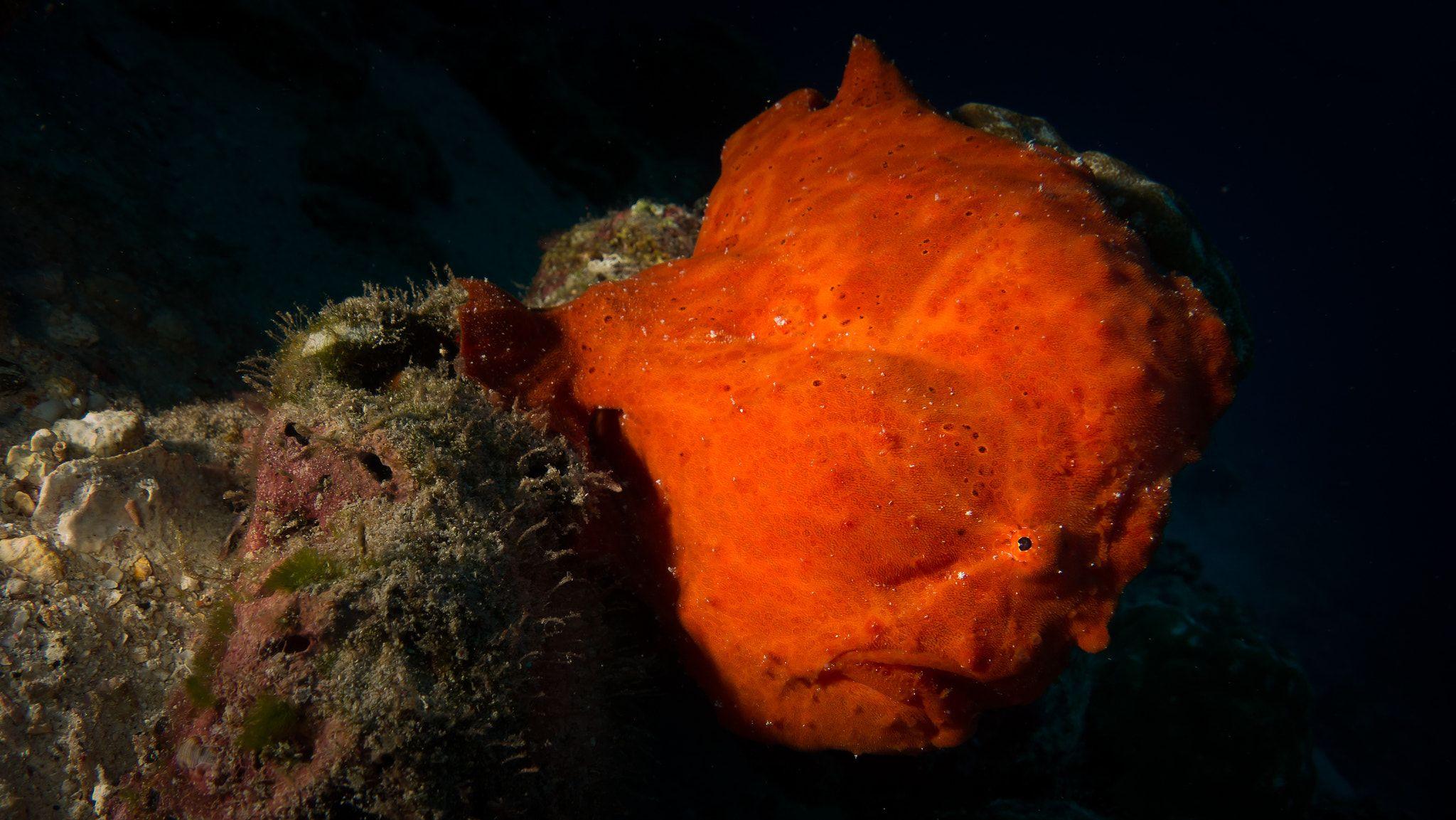
Giant Frogfish
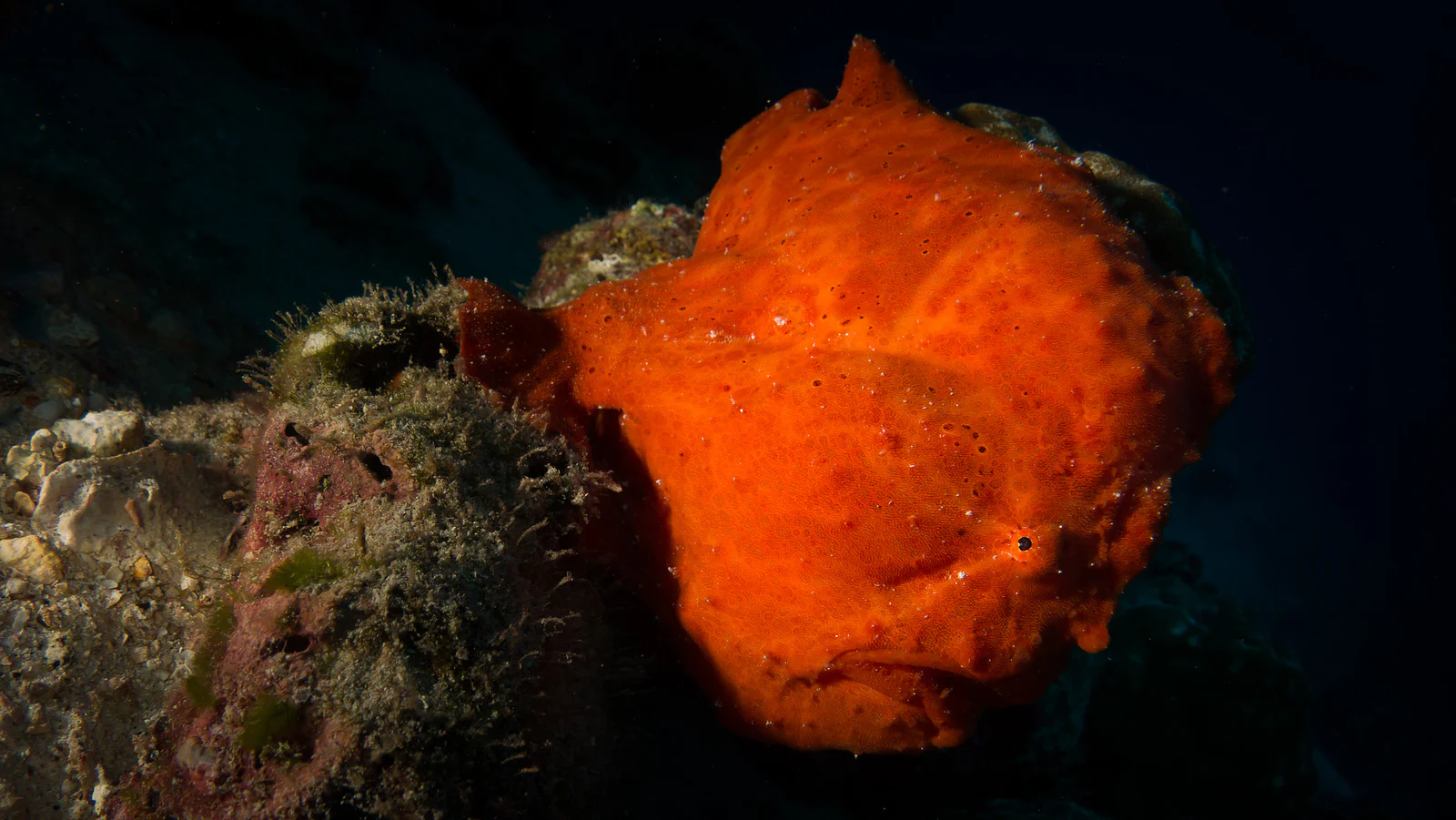
Antennarius commerson
About Giant Frogfish.
The Giant Frogfish, Antennarius commerson, is a fascinating member of the Antennariidae family, renowned for its extraordinary camouflage and unique hunting strategy. Classified as Least Concern, this species is a highlight for divers seeking macro marine life. It inhabits tropical and subtropical waters across the Indo-Pacific, including the Red Sea, Indian Ocean, and eastern Pacific, typically found in lagoons and sheltered rocky and coral reefs. These masters of disguise often associate with large sponges, underwater ropes, or jetty pillars, blending seamlessly into their surroundings. They are generally observed at depths ranging from 0–70 m, with an average occurrence around 20 m.
As a benthic, solitary ambush predator, the Giant Frogfish spends most of its time motionless, patiently waiting for unsuspecting prey. It employs a remarkable technique known as aggressive mimicry, using a modified dorsal spine as a "fishing rod" to lure its meals. Despite their bulky appearance, they are voracious carnivores, primarily feeding on fish and crustaceans, and are capable of swallowing prey nearly their own size, or even twice their size, thanks to their highly distensible stomachs. While not strong swimmers, they utilize their modified pectoral and pelvic fins to "walk" or hop along the seafloor, or even use short bursts of water from their gill openings for propulsion.
Identification
- Size: The Giant Frogfish is one of the largest shallow-water anglerfishes, reaching a maximum size of 38 cm (15 inches).
- Body Shape: It possesses a distinctive globular, extensible, and stocky body that is high-backed, unstreamlined, and scaleless.
- Skin and Texture: Its soft skin is covered with small dermal spinules and often features wart-like protuberances, variably shaped scab-like blotches, and small eye spots (ocelli) that cleverly mimic the porous texture of sponges.
- Coloration: This species exhibits an extremely variable coloration, allowing it to perfectly match its environment. Individuals can range from white, cream, pink, yellow, red, green, brown, to black, often adorned with darker circular spots or blotches. They have the ability to change their color over a period of a few weeks to enhance their camouflage.
- Mouth: A prominent feature is its large, upward-pointed, and prognathous (protruding lower jaw) mouth, which can expand rapidly in milliseconds to engulf prey.
- Illicium and Esca (Lure): The most defining characteristic is the modified first dorsal spine, called the illicium, which acts as a "fishing rod." This illicium is often darkly banded and approximately twice the length of the second dorsal spine. At its tip is the esca, a fleshy lure that typically resembles a small fish, shrimp, or worm, which the frogfish wiggles with jerky movements to attract unsuspecting prey. Both the illicium and esca can be retracted into a depression on its head for protection.
- Fins: Its pectoral fins are angled and limb-like, featuring an elbow-like joint, which are used for "walking" on the substrate and bracing. The pelvic fins also assist in movement and maintaining a stable position for ambush. The small, round gill openings are discreetly located behind the pectoral fins.
For divers, spotting a Giant Frogfish requires a keen eye due to its exceptional camouflage. They are commonly observed at dive sites such as Cannibal Rock, Three Sisters, and Dungon Wall, and occasionally at Diver's Heaven, Balicasag Sanctuary (Rico's Wall), Napaling Reef, Gorgonian Wall, and Snappers.
Where it lives.
This fascinating species inhabits tropical and subtropical waters, ranging from the Red Sea and South Africa eastward to Panama, extending north to southern Japan and the Hawaiian Islands, and south to the Lord Howe and Society Islands.
Divers can typically encounter the Giant Frogfish in a variety of ecosystems:
- Reefs: It is commonly found in lagoons and on sheltered rocky and coral reefs. Its mottled skin, often covered with wart-like protuberances, allows it to mimic the texture and coloration of its surroundings, making it incredibly difficult to spot.
- Sponges: A favored hiding spot, Giant Frogfish are frequently associated with large sponges, often perching directly on them and adopting their color and patterns. This allows them to ambush unsuspecting prey.
- Man-made Structures: These adaptable fish can also be found on underwater ropes, jetty pillars, and even within the structures of old sunken wrecks.
- Seagrass Beds: In some areas, they also inhabit seagrass beds, further demonstrating their ability to adapt to different benthic environments.
The Giant Frogfish is a benthic species, meaning it primarily lives on the seafloor. It is typically observed at depths ranging from 0 to 70 m, with an average occurrence around 20 m. While often found in shallower reef areas down to about 30 m, they can occasionally be seen in deeper waters. Their modified pectoral and pelvic fins allow them to "walk" or hop across the bottom, maintaining a stable position for ambush predation rather than actively swimming.
How it behaves.
The Giant Frogfish (Antennarius commerson) is a master of camouflage and a fascinating subject for macro enthusiasts at many dive sites, including Cannibal Rock, Three Sisters, and Dungon Wall. This species, reaching up to 38 cm (15 in) in length, is a benthic inhabitant of lagoons and coral reefs, typically found at depths of 1 to 50 m, though most commonly observed at less than 20 m.
Underwater Encounter Behavior
- Camouflage and Sedentary Nature: Giant Frogfish are renowned for their exceptional camouflage, allowing them to blend seamlessly with their surroundings, often resembling sponges, corals, or rocks. Their skin is covered with dermal spinules, wart-like protuberances, and blotches that further enhance this disguise. They can change their color and texture over days to weeks to match their environment, ranging from yellow, orange, green, brown, black, white, grey, red, or even purple. Divers often need a keen eye to spot them, as they remain incredibly still, supported by their modified pectoral and pelvic fins.
- Movement: While generally sedentary, Giant Frogfish are poor swimmers due to the absence of a swim bladder. For short distances, they "walk" or hop across the seafloor using their hand-like pectoral and pelvic fins. If threatened or needing to move further, they can employ a form of jet propulsion by rapidly expelling water through their small, circular gill openings located behind their pectoral fins.
- Diver Interaction: When a diver is spotted, a Giant Frogfish typically ceases any lure movement and remains motionless, further relying on its camouflage.
Feeding Habits
- Ambush Predator: The Giant Frogfish is a classic "lure-and-strike" ambush predator. It remains perfectly still, waiting for unsuspecting prey to come within striking distance.
- Luring Mechanism: Its most distinctive feature is the illicium, a modified first dorsal spine that acts as a "fishing rod," topped with an esca (lure). This lure mimics a small fish, worm, or shrimp and is actively wriggled or moved in jerky, up-and-down motions to attract prey. If the lure is bitten off, a new one can regrow within a few months.
- Diet: As a voracious carnivore, the Giant Frogfish preys mainly on fish and crustaceans. Its large, protractile mouth can expand rapidly, creating a vacuum that sucks in prey whole in a matter of milliseconds, even consuming animals nearly as large as itself.
Social Structure
- Solitary Lifestyle: Giant Frogfish are generally solitary creatures, preferring a benthic existence.
- Reproduction: They gather only during the mating period. During courtship, the male, typically smaller than the female, approaches and nudges her. The pair then rises from the seafloor towards the surface for a "nuptial parade." The female releases a large, ribbon-like, gelatinous egg mass (known as an "egg raft" or "veil") containing thousands of tiny eggs, which are immediately fertilized by the male. This egg mass floats with the current, and the eggs hatch after a few days. After fertilization, the pair disperses, and the female may even consume the male if he remains too close. The larvae are pelagic and drift for several weeks to months, already possessing a lure.
Notable Seasonal Patterns Relevant to Divers
- Year-Round Presence: Giant Frogfish can generally be observed year-round in their tropical Indo-Pacific habitats.
- Mating Season: While specific seasonal peaks for mating may vary by region, their reproductive behavior involves a temporary gathering, which could offer divers a rare chance to observe more than one individual together, though this is brief.
- Habitat Preference: Divers are most likely to encounter them in areas rich with sponges, on rocky and coral reefs, or even on artificial structures like wrecks and jetty pillars, where their camouflage is most effective.
Where to see it.
Evidence for philippines · 8 dive sites
General range is not evidence of occurrence at a specific dive site.
Balicasag Sanctuary (Rico's Wall)
Panglao
Site occurrence not yet documented
Season not yet documented
No dated observations available.
Diver's Heaven
Panglao
Site occurrence not yet documented
Season not yet documented
No dated observations available.
Dungon Wall
Puerto Galera
Site occurrence not yet documented
Season not yet documented
No dated observations available.
Gorgonian Wall
Cabilao Island
Site occurrence not yet documented
Documented site seasonality: Jan, Feb, Mar, Apr, May, Jun, Jul, Aug, Sep, Oct, Nov, Dec
No dated observations available.
La Laguna Point
Puerto Galera
Site occurrence not yet documented
Season not yet documented
No dated observations available.
Napaling Reef
Panglao
Site occurrence not yet documented
Season not yet documented
No dated observations available.
Snappers
Anda
Site occurrence not yet documented
Documented site seasonality: Jan, Feb, Mar, Apr, May, Jun, Jul, Aug, Sep, Oct, Nov, Dec
No dated observations available.
The Hill
Puerto Galera
Site occurrence not yet documented
Season not yet documented
No dated observations available.
Gallery.