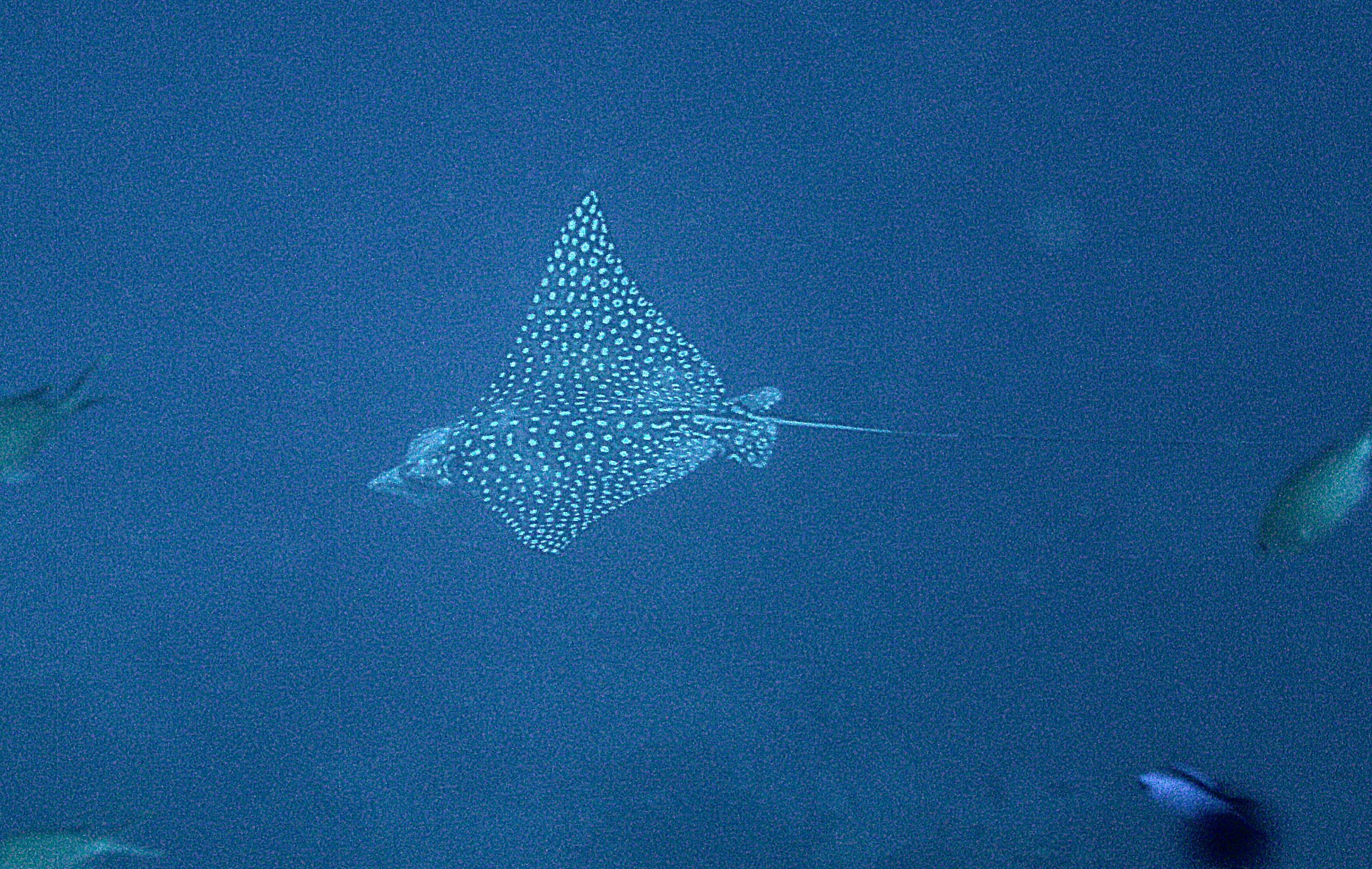
Spotted Eagle Ray
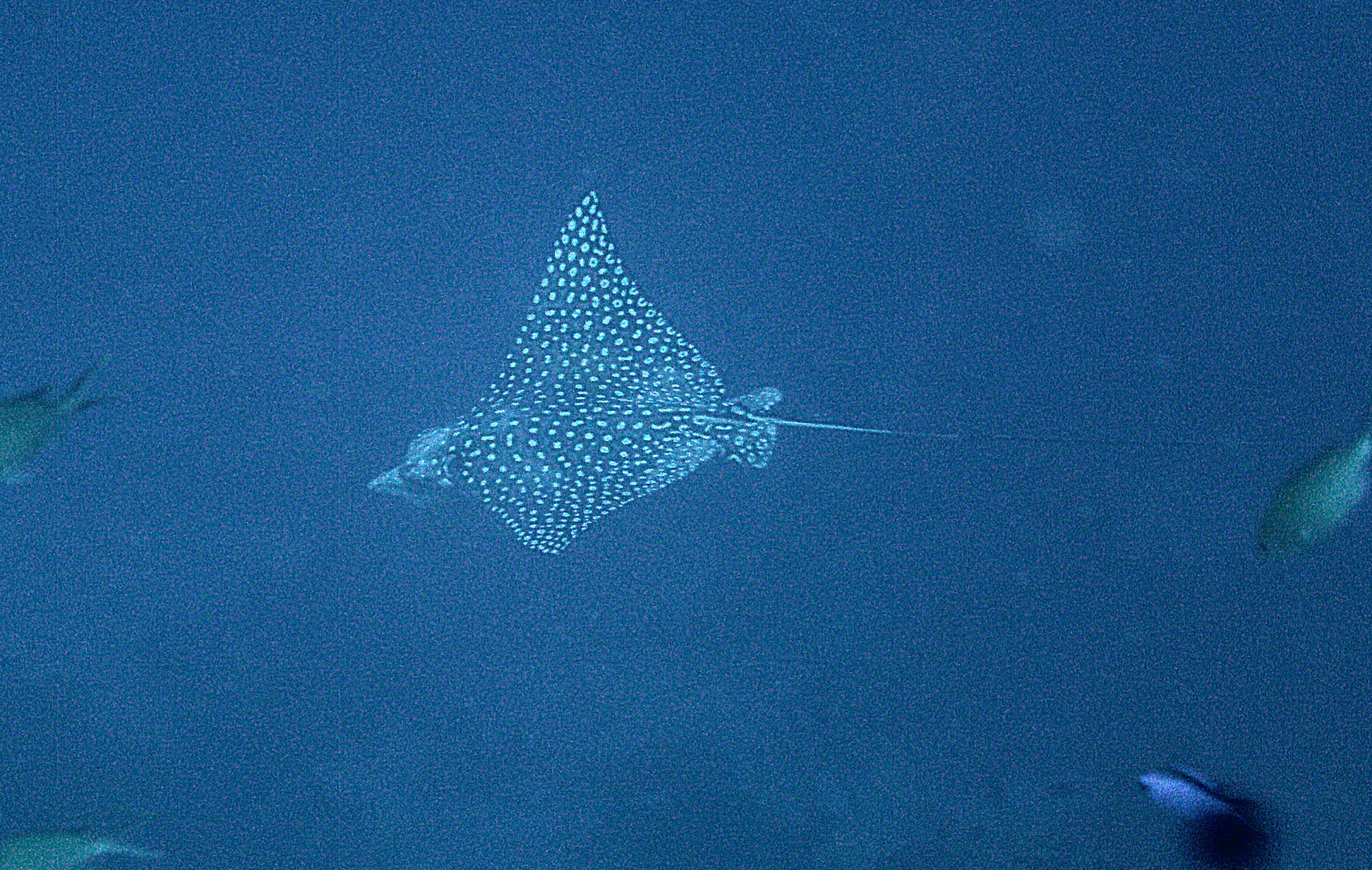
Aetobatus narinari
About Spotted Eagle Ray.
The Spotted Eagle Ray, Aetobatus narinari, is one of the ocean's most captivating inhabitants, renowned for its striking appearance and graceful, bird-like movement through the water column. Belonging to the family Aetobatidae, these cartilaginous fish are a highlight for divers in tropical and warm temperate waters worldwide. Their distinctive patterns and elegant swimming style make them instantly recognizable and a truly memorable encounter at any dive site. Often observed gliding solo or in small squadrons, they are active swimmers that rarely rest motionless on the seafloor.
Identification
The Spotted Eagle Ray is easily identified by its unique physical characteristics. Its body is a broad, flattened, diamond-shaped disc, typically dark blue, black, or dark gray on the dorsal (upper) side, adorned with a scattering of white, bluish-white, greenish, or pearly spots or rings. These spot patterns are unique to each individual, much like human fingerprints, allowing researchers to distinguish between them. The ventral (underside) surface is a contrasting pure white.
A prominent feature is its distinctive, broad, and flat snout, which is often described as shovel-shaped or resembling a duck's bill. This specialized snout is perfectly adapted for foraging, allowing the ray to probe and dig in the sand for buried prey. The large, wing-like pectoral fins are broad with pointed tips, enabling their characteristic undulating "flight" through the water. The eyes and large spiracles (openings for water intake) are located on the sides of its head.
Perhaps its most dramatic feature is its exceptionally long, whip-like tail, which can be two to three times the length of its body disc when undamaged. Unlike many other rays, the Spotted Eagle Ray lacks a caudal fin. Near the base of this tail, just behind a small dorsal fin, are several (typically 2 to 6) venomous, barbed spines used for defense. Adults can reach an impressive wingspan of up to 3.3 meters (11 feet) and a total length, including the tail, of over 5 meters (16 feet), with a maximum recorded weight of 230 kg (507 pounds).
Habitat and Distribution
Spotted Eagle Rays are found in tropical and warm temperate waters across the globe, inhabiting the Atlantic, Pacific, and Indian Oceans. However, recent taxonomic studies suggest that the true Aetobatus narinari may be restricted primarily to the Atlantic Ocean, with Indo-Pacific and Eastern Pacific populations now recognized as distinct species (Aetobatus ocellatus and Aetobatus laticeps, respectively). Regardless of the precise species delineation, these rays prefer shallow coastal waters, commonly frequenting bays, lagoons, estuaries, and coral reefs, as well as sandy or muddy bottoms adjacent to reefs. They are often observed at depths ranging from the surface down to 60 meters, though they can occasionally be found as deep as 80 meters. They thrive in waters with temperatures typically between 24–29°C.
While often associated with coastal environments, Spotted Eagle Rays are also pelagic, spending a significant portion of their time swimming in open water, sometimes in large schools close to the surface, and are known to travel long distances. Divers have the opportunity to encounter this magnificent species at various dive sites, including SS Yongala (common), Crystal Bay (occasional), Karang Makassar (Manta Point) (occasional), Castle Rock (occasional), Crystal Rock (occasional), Shotgun (The Cauldron) (occasional), Tatawa Kecil (occasional), Mawan (occasional), Three Sisters (occasional), and Sombrero Island (occasional).
Behavior and Diet
Spotted Eagle Rays are active and graceful swimmers, appearing to "fly" through the water with powerful, undulating movements of their pectoral fins. While they can be observed alone, they frequently form schools, sometimes comprising dozens of individuals, especially during non-breeding seasons or when traversing open water. A remarkable behavior is their tendency to leap completely out of the water, sometimes several feet high, a spectacle that scientists believe may be related to escaping predators, removing parasites, or communication.
As benthic foragers, their diet primarily consists of bottom-dwelling invertebrates. They use their shovel-shaped snouts to dig into the sand and mud, unearthing prey such as clams, oysters, gastropods, bivalves, crabs, shrimp, octopus, squid, and sea urchins. Their jaws are equipped with a single series of broad, flat, chevron-shaped teeth fused into a plate, perfectly adapted for crushing the hard shells of their prey. They also possess papillae in their mouths to help separate shells from flesh before ingestion. They are known to forage particularly actively during high tide.
Conservation Status
The conservation status of the Spotted Eagle Ray (Aetobatus narinari, as traditionally recognized globally) is listed as Endangered by the IUCN Red List. However, some sources, particularly those referring to the broader, undifferentiated global population, may still classify it as "Near Threatened," noting significant population declines worldwide. The species faces numerous threats, including accidental capture (bycatch) in commercial and artisanal fisheries, habitat degradation, reduced food availability due to overfishing and ocean acidification, ocean noise, and pollution. Their low reproductive potential, with females giving birth to only 1 to 4 live pups after internal incubation, makes them particularly vulnerable to population declines. Conservation efforts are crucial, with some regions implementing protective legislation, such as outlawing fishing, landing, purchasing, and trading of the species.
Where it lives.
The spotted eagle ray, Aetobatus narinari, is a highly distinctive and graceful inhabitant of tropical and warm temperate marine environments worldwide. These magnificent rays are frequently encountered by divers in a variety of coastal ecosystems, showcasing their adaptability and wide-ranging movements.
Habitat and Ecosystems:
- Spotted eagle rays are commonly found in shallow inshore waters, including vibrant coral reefs and expansive bays.
- They are often associated with reef edges, where they can be observed gliding along the interface between the reef structure and open water.
- Beyond reef environments, they also frequent sand flats, seagrass beds, and areas with soft bottoms composed of mud, sand, and gravel, where they forage for prey.
- While primarily coastal, these rays are also pelagic, meaning they spend significant time swimming in the open ocean, often near the surface, and are known to cross vast oceanic basins.
- Occasionally, they venture into brackish environments such as estuaries and mangrove swamps.
Depth Range:
- Spotted eagle rays typically inhabit waters from the surface down to depths of 80 m.
- In inshore areas, they are frequently observed at depths up to 60 m.
Geographic Distribution:
As traditionally recognized, Aetobatus narinari boasts a global distribution across tropical and warm temperate waters. This includes the Western Atlantic (from North Carolina and Florida, USA, through the Gulf of Mexico and Caribbean to southern Brazil), the Eastern Atlantic (from Mauritania to Angola), the Indo-West Pacific (from the Red Sea and South Africa to Hawaii, extending north to Japan and south to Australia), and the Eastern Pacific (from the Gulf of California to Peru, including the Galapagos Islands). It is important for divers to note that recent scientific research suggests that what was once considered a single species, Aetobatus narinari, may actually be a complex of several distinct species, with the Atlantic population retaining the name A. narinari and other populations being recognized under different scientific names.
Observed Dive Sites:
Divers frequently encounter spotted eagle rays at renowned dive sites such as the SS Yongala (common), Crystal Bay (occasional), Karang Makassar (Manta Point) (occasional), Castle Rock (occasional), Crystal Rock (occasional), Shotgun (The Cauldron) (occasional), Tatawa Kecil (occasional), Mawan (occasional), Three Sisters (occasional), and Sombrero Island (occasional).
How it behaves.
The Spotted Eagle Ray (Aetobatus narinari) is a captivating species for divers, known for its graceful movements and distinctive white spots against a dark dorsal surface. With a maximum wingspan of 3.3 m (11 ft), these rays are often a highlight at dive sites such as the SS Yongala, Crystal Bay, and Karang Makassar.
Underwater Encounter Behavior
Spotted Eagle Rays are generally considered shy and wary of divers, often swimming away quickly if approached too closely. While they possess several venomous, barbed stingers near the base of their long, whip-like tail for defense, they are not aggressive towards humans unless provoked or improperly handled. Divers are advised to maintain a respectful distance, allowing these magnificent creatures to choose their direction and observe them as they glide effortlessly through the water. Occasionally, these rays are observed leaping completely out of the water, a behavior whose exact purpose is debated but may be related to dislodging parasites, evading predators, or communication.
Feeding Habits
Spotted Eagle Rays are benthic feeders, primarily preying on a variety of invertebrates found on or within sandy and muddy bottoms. Their diet mainly consists of bivalves like clams and oysters, gastropods such as whelks, crustaceans including shrimp and crabs, as well as octopuses, worms, and sea urchins. They possess a unique, shovel-shaped snout and specialized chevron-shaped dental plates, which they use to dig into the sand to unearth buried prey. Once prey is located, often with the aid of electro-sensory cells on their snouts, they crush the hard shells with their powerful jaws, spitting out the shell fragments and consuming only the soft tissues.
Social Structure
While Spotted Eagle Rays can sometimes be observed alone, they are often social animals, frequently forming groups or "fevers" that can range from a few individuals to large schools of up to hundreds. These groups often swim in coordinated formations, such as single lines, horizontal lines, or diamond shapes, moving together with synchronized movements. During non-reproductive periods, these schools may even be sex-segregated. They exhibit high site fidelity, often returning to specific areas for resting during low tide and moving into shallower lagoonal areas, sand flats, seagrass beds, and coral reefs to forage during high tide.
Notable Seasonal Patterns
Spotted Eagle Rays are migratory, with their movements influenced by seasonal changes in water temperature, food availability, and ocean currents. They prefer tropical and subtropical waters, typically found in temperatures ranging from 22.3°C to 29°C. Divers in certain regions, such as Cozumel and Isla Mujeres, Mexico, have a higher chance of encountering large aggregations of these rays during specific seasons, typically from December through March, with January and February often being peak months. During these times, they migrate closer to coastal areas and dive sites, utilizing natural corridors and abundant feeding grounds. While they spend the majority of their time in the upper 10 m of the water column, they can be found in coastal habitats down to 60 m, and occasionally deeper, with some individuals recorded at depths of 80 m or even 50.5 m in specific locations.
Where to see it.
Evidence for philippines · 10 dive sites
General range is not evidence of occurrence at a specific dive site.
Cathedral
Panglao
Site occurrence not yet documented
Documented site seasonality: Nov, Dec, Jan, Feb, Mar, Apr, May
No dated observations available.
Coral Garden
Coron
Site occurrence not yet documented
Season not yet documented
No dated observations available.
Doljo Point
Panglao
Site occurrence not yet documented
Documented site seasonality: Nov, Dec, Jan, Feb, Mar, Apr, May
No dated observations available.
Fish Bowl
Puerto Galera
Site occurrence not yet documented
Documented site seasonality: Dec, Jan, Feb, Mar, Apr, May
No dated observations available.
Kyokuzan Maru
Coron
Site occurrence not yet documented
Season not yet documented
No dated observations available.
Monad Shoal
Malapascua
Site occurrence not yet documented
Season not yet documented
No dated observations available.
Morazan Maru
Coron
Site occurrence not yet documented
Documented site seasonality: Apr, May
No dated observations available.
Paglugaban
El Nido
Site occurrence not yet documented
Season not yet documented
No dated observations available.
Popolcan (Under Water Forest)
El Nido
Site occurrence not yet documented
Season not yet documented
No dated observations available.
Sombrero Island
Anilao
Site occurrence not yet documented
Season not yet documented
No dated observations available.
Gallery.